
Codex Leningradensis (1006-7)
Lisbon Bible (1492)
Rabbinic Bible (1524-5)



Ginsburg/BFBS edition (1908)
Biblia Hebraica Stuttgartensia (1976)
Stone edition of Tanach (1996)
| Title: | New proposal on the Hebrew vowel HOLAM |
| Source: | Peter Kirk, Avi Shmidman, John Cowan, Ted Hopp, Trevor Peterson, Kirk Lowery, Elaine Keown, Stuart Robertson |
| Status: | Individual Contribution |
| Action: | For consideration by the UTC |
| Date: | Second draft of new proposal 2004-07-23 |
This proposal replaces the proposal made to the June 2004 UTC meeting as document L2/04-193 (also available as http://qaya.org/academic/hebrew/Holam.pdf). In this much shorter proposal there is no longer a set of options for consideration, but a single recommendation to the UTC. A separate background document (*** in preparation ***) gives more details of the issues and options discussed during preparation of this proposal.
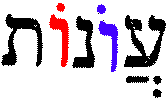
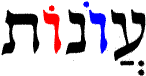
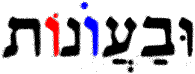
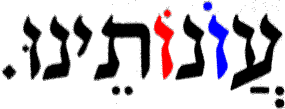
The Hebrew point HOLAM combines in two different ways with the Hebrew letter VAV. In the first combination, known as Holam Male, the VAV is not pronounced as a consonant, and HOLAM and VAV together serve as the vowel associated with the preceding consonant. In the second combination, known as Vav Haluma, the HOLAM is the vowel of a consonantal VAV. In high quality typography Holam Male is distinguished from Vav Haluma: Holam Male is written with the HOLAM dot above the right side or above the centre of VAV; and Vav Haluma is written with HOLAM above the top left of VAV. The distinction is clear and significant in some texts, dating from the 10th century CE to the present day. In modern printing, the distinction is made in biblical and liturgical texts, in poetry, and in educational materials; indeed in general where it is important to indicate the exact pronunciation of words which may not be familiar to readers. Normally the only graphical difference is in the relative positions of the VAV and HOLAM glyphs; occasionally small differences in one or other of the glyphs are also seen. See the samples in the figures below. But in less exacting typography Holam Male and Vav Haluma are not distinguished, and usually both rendered with the HOLAM dot above the centre of VAV. Holam Male is very common in pointed Hebrew texts; Vav Haluma is much less common, especially in modern Hebrew.
Note carefully that this is not a proposal to encode a phonetic distinction which is not made graphically. Rather, it is a proposal to encode a graphical distinction with a 1000 year history. This graphical distinction is made in a significant minority of modern texts, and it must be made when the phonetic distinction needs to be indicated unambiguously.
Unicode does not currently specify how to distinguish between Holam Male, Vav Haluma, and the
undifferentiated combination. Several different ways have been used in
existing texts,
or recommended for use with Unicode Hebrew fonts. To avoid
proliferation of ad hoc
solutions, it is proposed here that the UTC indicate its approval of
the specific representations proposed here.
For further details, see the separate background document.
There has been an extensive debate, including at the June 2004 UTC meeting, about how best to distinguish between Holam Male and Vav Haluma in Unicode. A large number of options have been put forward and evaluated; see the separate background document for a list of these proposals and an evaluation of each of them. A consensus has now been reached among a group of users of both biblical and modern Hebrew that the representations proposed here are the most likely to be generally acceptable. This group of users hereby requests the UTC to indicate its agreement that these representations are acceptable and should be recommended for general use to Hebrew users and to font designers; also to specify these representations in the text of the next version of The Unicode Standard. UTC agreement is required because the proposed representation involves the use of ZWNJ (i.e. U+200C ZERO WIDTH NON-JOINER).
The proposal is that Vav
Haluma should be represented as <VAV, ZWNJ,
HOLAM>, whenever there is a potential need to distinguish
it from Holam Male. Holam Male should continue to be
represented, as in the majority of existing texts, as <VAV,
HOLAM>, and this same sequence may be used for a
combination of VAV with HOLAM when a
representation which does not distinguish between Holam Male
and Vav Haluma is intended.
This proposal is based on the fundamental nature of Holam Male and Vav Haluma as distinct renderings
of the combination of the same pair of characters VAV
and
HOLAM. From a graphical viewpoint they differ primarily
in that in the former the HOLAM dot is placed in a
different position from its normal one
relative to the base character, indicating a special close connection
between VAV and HOLAM. Thus Holam Male and Vav Haluma are respectively more
and
less connected renderings of the same character pair VAV
and HOLAM. Indeed, Holam
Male is commonly understood, and is implemented in many existing
fonts, as a ligature between VAV and HOLAM;
this also reflects its logical and linguistic nature, because Holam Male represents a single
sound, long O, whereas Vav Haluma
represents a sequence of separate sounds, VO. Because Holam Male is much more common than
Vav Haluma, this ligature is
taken as the default. The function of ZWNJ in the
proposed representation of Vav Haluma,
in accordance with its description in section 15.2 of The Unicode Standard (TUS)
version 4.0.1 (http://www.unicode.org/versions/Unicode4.0.0/ch15.pdf),
is to inhibit this ligature formation or equivalently to select the
less connected rendering of VAV with HOLAM,
appropriate for Vav Haluma,
in which the HOLAM
dot is placed in its regular top left position relative to the base
character.
This use of a sequence including ZWNJ is in accordance with the revised definitions in TUS version 4.0.1 (http://www.unicode.org/versions/Unicode4.0.1/), in that ZWNJ is used within a combining character sequence immediately after the base character. According to the approved minutes of the February 2004 UTC meeting (http://www.unicode.org/consortium/utc-minutes/UTC-098-200402.html) the UTC made a specific decision to allow such sequences:
[98-C33] Consensus: Allow U+200D ZERO WIDTH JOINER and U+200C ZERO WIDTH NON-JOINER in combining character sequences. The interpretation of a joiner or a nonjoiner between two combining marks is not yet defined.
There is a precedent for such a sequence in the <base character, ZWNJ,
combining mark> sequence defined for Bengali Reph and Ya-phalaa in TUS
version 4.0.1.
It is recognised that there are some short term practical
difficulties with current rendering engines in rendering the proposed
sequence for Vav Haluma,
especially on the rare occasions (essentially only in the biblical
text) in which an accent is also combined with this VAV
and HOLAM.
However, encoding decisions should be based on the principles decided
by the UTC rather than on the peculiarities of current implementations.
The main reason for preferring this proposal to other
suggestions, especially those involving encoding of new characters, is
that it is least disruptive of existing data. There is a
considerable body of existing pointed Hebrew data in which Holam Male is represented as <VAV,
HOLAM> (including for example 6,290 web pages found
by Google containing the common word <LAMED, VAV,
HOLAM>). Changing the representation of this very
common letter at this stage, or recommending continuing use of two
alternative and incompatible representations, would result in massive
data representation
ambiguities for Hebrew data. The continuing existence of incompatible
representations would create a
significant data mapping problem at the interface between the domains
of the two different representations of Hebrew texts. Holam Male would be represented in
biblical, liturgical, poetic and educational texts by a Unicode
sequence which would
appear, in rendering, to be the existing widely used sequence <VAV,
HOLAM>, but
which would in fact not be treated as equivalent to this sequence. This
would create a de facto
situation where the same Hebrew
data would be represented in Unicode in one way in biblical,
liturgical, poetic and educational texts and in an incompatibly
different way outside such texts.
In most of the current data Vav
Haluma, when it occurs, is represented by the same sequence <VAV,
HOLAM>, but it is very much less common than Holam Male (a little over 1% of the
frequency of Holam Male
in the Hebrew Bible, probably even rarer in modern Hebrew). Therefore
the disruption to existing data in changing its representation,
although the same in principle as for Holam
Male, is quantitatively much less serious.
Obviously, in order to distinguish Holam
Male from Vav Haluma
in plain text it is necessary to change the Unicode representation of
one or the other, or of both. But the practical adverse consequences of
a change of representation are considerably reduced if a new
representation is chosen which automatically falls back to the existing
representation when processed by processes (including rendering,
collation and general character and text processing) which have not
been specifically set up to recognise the distinction between Holam Male and Vav Haluma. Precisely this
automatic fallback is the default if a representation is used which
consists of the existing representation plus a default ignorable
control character. Variation selectors as currently defined cannot be
used with combining characters,
and CGJ cannot support a graphical distinction. But ZWJ
and ZWNJ, as defined in TUS
version 4.0.1, are available for control of ligature formation in this
context, and so are suitable for distinguishing Holam Male from Vav Haluma. Specifically, ZWNJ
is appropriate for a marked representation of Vav Haluma, because this is
graphically and logically a less connected rendering of VAV
with HOLAM than Holam
Male.
An additional argument against solutions involving new
characters is that, from the abstract character perspective, Holam Male and Vav Haluma are made up of the same VAV
and HOLAM characters, but in different combinations. It
is important for all kinds of character processing that the fundamental
identities of the Hebrew characters VAV and HOLAM
not be confused
by representing either of them with two different Unicode characters.
Indeed, it would be a breach of the Unicode character/glyph model to
encode a new HOLAM character for what is essentially a
contextual glyph variant of a single abstract character.
The current proposers wish to minimise the extent of disruption of existing Hebrew data, as well as to represent the abstract characters of the Hebrew script properly according to the Unicode character/glyph model. For this reason they wish to indicate the following definite preferences:
Solutions are preferred in which the marked representation is distinguished from the unmarked by default ignorable control characters, and which do not require definition of any new combining characters.
The representations in the current proposal agree most closely of
all of the options considered with these preferences as well as with
the general definitions in The
Unicode Standard. They are therefore recommended to the UTC for
its approval.
|
|
|
|
|
Codex Leningradensis (1006-7) |
Lisbon Bible (1492) |
Rabbinic Bible (1524-5) |
|
|
|
|
|
Ginsburg/BFBS edition (1908) |
Biblia Hebraica Stuttgartensia (1976) |
Stone edition of Tanach (1996) |
Figure 1: Holam Male (marked in red) and Vav Haluma (marked in blue) distinguished in ancient and modern editions of the Hebrew Bible - these words are from Genesis 4:13. (If the colours are not visible: In each image, the third base character from the right, with the dot above its right side or its centre, is Holam Male; the third base character from the left, with the dot above its left side, is Vav Haluma.)
|
|
|
Figure 2: Holam Male (left, twice, red, from p.529) and Vav Haluma (right, blue, from p.528) contrasted in Keil & Delitzsch Commentary on the Old Testament, vol.1, reprint by Hendrickson, 1996 (Hebrew words quoted in English text).

Figure 3: Holam Male (right Hebrew word, red) and Vav
Haluma (left word, blue)
contrasted
in Langenscheidt's Pocket Hebrew
Dictionary, p.243.
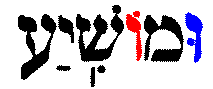
Figure 4: Holam Male (red) written with a different glyph from a regular VAV (blue), from Siddur Tikkun Meir Hashalem, R. Greenfield, 1982.
|
|
|
|
|
Yose ben Yose (5th century), from sidrei avodah for yom hakipurim ("etain tehila"), in Goldschmidt, Mahzor L'yamim Nora'im, Koren Publishing 1970, p464 |
R. Elazar Hakalir (poetry of the late 6th century), from piyyut for Shavuot, "eretz mateh", in Shulamit Elizur, Kedushtaot l'yom matan torah, Meketzei Nirdamim, 2000, p116 |
Midrash Tanchuma (8th century), Or haHayim, v1, 1998, p185 |
|
|
||
|
Yannai (poet of the early 6th century), from kedushta piyyut "ashrei mo'asei alrla", in Zaulai, Piyyute Yannai, Shocken Publishing, 1938, p32 |
||
Figure 5: Holam Male (red) and Vav Haluma (blue) distinguished in modern editions of
mediaeval Hebrew poetry and midrashic literature.
|
|
|
|
|
Mahzor Yom Hakippurim, Israel Ariel, ed., Makhon Hamikdash / Carta Publishing, 1995, p92 |
Siddur Tefila, Koren Publishing, 1996, p60 |
Hagada Shel Pesach, Torat Chaim series, Mosad Harav Kook, 1998, p142 |
Figure 6: Holam Male (red) and Vav Haluma (blue) distinguished in modern editions of
liturgical texts. Note the larger and higher HOLAM dots
in Vav Haluma in the right
hand two examples; other idiosyncratic distinctions are made especially
in Koren Publishing editions of such liturgical texts.