The E&S proposal refers, in sections C 2b and D, to discussion of these issues with the user community on the hebrew@unicode.org list, but it does not summarise the drift of this discussion. In fact the users of Hebrew script involved in this discussion have been almost unanimously opposed both to the principle of solving the problem by encoding a new character, and specifically to the solution in the E&S proposal. There is no general request or requirement for the proposed new character from the user community, but rather a general opposition to it. The only exceptions have been a few users who have argued reluctantly that such a solution might be preferable because of inadequacies of current implementations; but standardisation should not be driven by accommodation to existing implementations. The raw archives of these discussions are accessible at http://www.unicode.org/~ecartis/hebrew/.
The most serious objection to encoding the new character HEBREW POINT HOLAM HASER FOR VAV is that this character is identical to the existing U+05B9 HEBREW POINT HOLAM both in its semantics and in its visual appearance. The answers in sections C 8a and C 10c of the E&S proposal are seriously misleading: there is no general distinction in position, size or height between the proposed character and the existing one. The reference glyphs in the proposal are also misleading. There is a graphical distinction only when these combining characters are combined with the base character U+05D5 HEBREW LETTER VAV; in this case U+05B9 HEBREW POINT HOLAM is generally rendered further to the right, relative to the base character, than its usual position, whereas the proposal is for the new HEBREW POINT HOLAM HASER FOR VAV to retain its regular position. At the level of interpretation, the distinction here is in the VAV, which is a consonant in Vav Haluma (VAV with Holam Haser) but silent in Holam Male, rather than in the Holam, which has the identical function and pronunciation in both cases.
The image 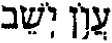 ,
from Isaiah 26:21 in the Stone Tanakh, one of the most respected
editions of the Hebrew Bible,
illustrates that Holam Haser
is identical in its glyph and its position relative to the base
character when combined with VAV (second base character
from the right) and with YOD (third base character from
the left); in this text, as in most texts, the glyphs for VAV
and YOD differ only in their lower parts. But the
E&S proposal is that two different characters should be used for
the graphically identical combining mark when only the base characters
are different, and when their interpretations are identical.
,
from Isaiah 26:21 in the Stone Tanakh, one of the most respected
editions of the Hebrew Bible,
illustrates that Holam Haser
is identical in its glyph and its position relative to the base
character when combined with VAV (second base character
from the right) and with YOD (third base character from
the left); in this text, as in most texts, the glyphs for VAV
and YOD differ only in their lower parts. But the
E&S proposal is that two different characters should be used for
the graphically identical combining mark when only the base characters
are different, and when their interpretations are identical.
The E&S proposal seems to treat the HOLAM in Vav Haluma as specially marked, whereas in fact the marked case, both graphically and semantically, is Holam Male. The logical implication of this is that it would be theoretically preferable to encode a new variant Holam character for use only in the combination Holam Male (or for all cases of Holam Haser, but this would be slightly more disruptive: in the Hebrew Bible, of all occurrences of HOLAM about 47% are part of Holam Male and 53% are Holam Haser, and Holam Male is relatively more frequent in modern Hebrew). This would correspond to the actual graphical distinction, and to a small semantic distinction between the functions of the Holam dots. However, such solutions have been unanimously rejected by both sets of proposers and on the hebrew@unicode.org list, because they would require an incompatible change to a large body of existing texts, in which both varieties of Holam dot are represented by the same character.
The E&S proposal makes an inappropriate comparison between the case for the proposed character HEBREW POINT HOLAM HASER FOR VAV and the accepted proposal for HEBREW POINT QAMATS QATAN. These two cases are quite different, in several ways:
- The graphical distinction between Qamats Qatan and Qamats Gadol is a novel one, used in only a very few recently published special purpose texts, There are no known texts represented in Unicode in which a distinction is attempted. But the graphical distinction between Holam Male and Vav Haluma is an ancient one, made consistently for more than 1000 years in exact editions of certain texts. The distinction continues to be made in a large minority of existing pointed Hebrew texts: not only liturgical texts as stated in the E&S proposal, but also religious texts used for private and public study, and modern poetic and educational texts. (See the examples given in the Kirk et al proposal.) And there are several existing Unicode texts in which Holam Male and Vav Haluma are distinguished by a variety of non-standard mechanisms.
-
The new character HEBREW POINT QAMATS QATAN has been provisionally accepted on the basis that it has both a distinct graphical form and a distinct interpretation as indicating a variant pronunciation. Neither of these applies to HEBREW POINT HOLAM HASER FOR VAV, which differs from U+05B9 HEBREW POINT HOLAM neither in form nor in interpretation.
-
HEBREW POINT QAMATS QATAN may be used with all Hebrew base characters. The proposed HEBREW POINT HOLAM HASER FOR VAV may be used only with a single base character.
-
My own preference would have been to encode HEBREW POINT QAMATS QATAN not as a separate character but as a variant of U+05B8 HEBREW POINT QAMATS. However, since Qamats Qatan can occur with any Hebrew base character and with other combining characters e.g. DAGESH, the only available mechanism for selecting a variant would be a Variation Selector, and use of Variation Selectors with combining characters is not permitted. But there is no such restriction with Vav Haluma because only a single base character is involved, and because the UTC has recently approved an appropriate mechanism for indicating variant combinations of base characters with combining marks, by inserting ZWNJ or ZWJ after the base character.
The E&S proposal presupposes that the distinction between Holam Male and Vav Haluma is a semantic one. But
this is actually debatable. A distinction which is only optionally
marked cannot indicate a distinctive interpretation. Consider the
pointed Hebrew words מִצְוֹת mitzvot
"commandments", with Vav Haluma
pronounced [vo], and מַצּוֹת matzot
"wafers", with Holam Male
pronounced [o]. (I have been forced to represent Vav Haluma and Holam Male in the same way in these
two words.) Readers of pointed Hebrew are able to determine the correct
pronunciations of these words, but not so much from the unreliable
distinction between dot positions as from the rule that Vav Haluma must follow a vowel
(including SHEVA as here) but Holam Male must follow a consonant.
This shows that the semantic distinction is derived from the context
within the whole word, and not from the position of the Holam dot. Therefore the graphical
distinction between Holam Male
and Vav Haluma, although
important for the correct and exact rendering of the text, is not
actually semantically significant. This conclusion makes irrelevant the
argument against the Kirk et al proposal, made on the
hebrew@unicode.org list, that solutions using ZWNJ and ZWJ
are unsuitable for making semantically significant distinctions. On the
other hand, if the distinction is not semantic, the Unicode
character/glyph model implies that a new character should not be
encoded and so that the E&S proposal should be rejected.
It is stated in the E&S proposal that Holam Male "is no more a ligature
than ö is." I accept that neither of these is a ligature in the
conceptual sense which is probably intended by the Unicode definition
of "ligature", in http://www.unicode.org/versions/Unicode4.0.0/b1.pdf.
On the other hand, both of the sequences <VAV, HOLAM>
and <LATIN SMALL LETTER O, COMBINING DIAERESIS>
are commonly implemented within rendering systems as ligatures, i.e.
with "A glyph representing
a combination of two or more characters."
Now I accept that there was some confusion of terminology in the Kirk et al proposal, in the first paragraph after the heading "Justification". This is because when drafting that proposal I was thinking in terms of ligatures as used in rendering engines. It would have been more in accordance with Unicode definitions to write in more generic terms of more and less connected renderings. That proposal states: "Because Holam Male is much more common than Vav Haluma, this ligature is taken as the default. The function of ZWNJ in the proposed representation of Vav Haluma, ... is to inhibit this ligature formation or equivalently to select the less connected rendering of VAV with HOLAM, ...". This would have been better worded: "Because Holam Male is much more common than Vav Haluma, this more connected rendering is taken as the default. The function of ZWNJ in the proposed representation of Vav Haluma, ... is to select the less connected rendering of VAV with HOLAM, e.g. to inhibit rendering of them as a ligature, ..."
I accept also that the Kirk et al proposal is not theoretically
perfectly neat. It does involve some slight stretching of definitions,
but only in a benign way: while Holam
Male may not strictly be a ligature in the conceptual sense, it
is perfectly possible within the Unicode model to treat it as if it
were a ligature, and the results of doing so seem to be acceptable. It
is unfortunately impossible to find a theoretically perfect solution
which does not also undermine the stability of large amounts of data.
Nevertheless, the theoretical imperfections of the Kirk et al proposal
are far less than those of the E&S proposal, which ignores basic
Unicode principles such as the character/glyph model.
The E&S proposal is essentially a resubmission of an early Unicode proposal for a LEFT HOLAM character, which was provisionally assigned to U+05BA but never formally accepted (see http://www.unicode.org/mail-arch/unicode-ml/Archives-Old/UML019/0559.html). The UTC should review its reasons for previously rejecting this proposal before accepting it now. Nevertheless, this provisionally accepted character seems to have been widely implemented, including in the Microsoft 2003 distributions of the fonts Arial and Times New Roman (version 3.00 of each) as well as in the Fontographer program. One implication of this is that if the new character HEBREW POINT HOLAM HASER FOR VAV is accepted, it would be sensible to allocate it to U+05BA, and to reallocate the proposed and provisionally allocated HEBREW POINT QAMATS QATAN.