What good does it do when Christians are offended?

US Pledge of AllegianceDale Best has written a guest post, at Kurt Willems’ Pangea Blog, What Good Does It Do When Christians Are Offended?, copied from Dale’s own blog. The specific focus of the post is something I am not so interested in, the wording of the US Pledge of Allegiance. But the real point is much more important: that Christians should not be so quick to take offence.

Dale writes (in part):

I’m one of those Jesus followers who happened to not be offended. Because I don’t think it does any good. …

But how much good does it do? If we call ourselves Christians and we identify ourselves with the One who came and forsook his own rights and his own life and gave himself for others, should instances like removing “Under God” from a pledge really matter?

Jesus spent his time and influence and energy building a Kingdom that transcended anything this world had to offer. The world, essentially, has it’s own way of doing things and it never surprised him that things weren’t right. He came to reconcile those things that weren’t right … through serving and giving his life and ultimately defeating death.

Jesus didn’t come to tell everyone what he was against. He had one mission and that was to usher in His Kingdom to a world that was broken. He showed us love in a way that seemed so counter-cultural. He didn’t waste his time worrying about whether or not his Abba’s rules were posted in the town square. He taught that to be first, you have to be last. And to not expect the world to make it easy for you along the way.

Indeed. This ties up well with what I wrote about Calvin, Preacher of Legalism and about Why Christians should accept gay marriage. As Christians we shouldn’t expect the world to live by our standards, and we certainly shouldn’t take offence when they don’t.

It is right for us to be sad when we see such things, and for them to drive us to prayer. And sometimes it is right to speak out for truth and righteousness. But when instead we take offence and start complaining in a judgmental way, in fact we harm the cause of Christ, in the same way that Calvin did when he presided over a legalistic state in Geneva. This is true whether our offence is over the Pledge of Allegiance, over bad things we see in society, or over what some blogger has written.

How is this harmful? We give outsiders the false idea that Christianity is all about keeping rules and saying the right words. We make them feel condemned rather than loved by God. Instead of attracting them with the true gospel message, we repel them and cause them to reject any Christian faith that they might have. In short, we do great damage to the Kingdom of God.


Which Calvin has the better theology?

John CalvinCalvinIn case anyone is confused, the Calvin I was referring to in my post Calvin, Preacher of Legalism is the Reformer of Geneva, left, not the cute cartoon boy, right. But I’m not sure there is much to choose between their theologies as put into practice. One was profound but toxic, the other wrong but harmless.

Thanks to Jeremy Myers for informing me on the boy’s theology:

Calvin's theology

Free and Unrestricted Discipleship Resources

This is a great video from Door43 about how the church worldwide needs discipleship resources free from copyright restrictions. Copyright owners here in the West are seeking to enrich themselves while Third World churches are struggling for lack of the material they need. This is a scandal, but one which Door43 is working to overcome.

I note that among their projects is an Open Bible Translation, in English and to be released under an open licence.

The future of the global church is Open from Distant Shores Media on Vimeo.

Why Christians should accept gay marriage

Gay marriageJ. R. Daniel Kirk (no relation) put the cat among the pigeons last week when he blogged about Gay Marriage in New York and wrote:

As long as the state is in the marriage business, Christians should support gay marriage as an embodiment of our calling to love our neighbor as ourselves.

He then offered an explanation of his position, which he has summarised in a new post Gentiles and Homosexuals (Pt. 1) as follows:

I made the suggestion that Christians need to develop the habit of asking two separate questions, without predetermining what the relationship between them might be. The first is, “What does God require of us as God’s people?” and the second is, “What does this mean for our life in civil society populated by people who do not, and will not, agree with us?”

This is an important distinction, but one which is often lost. As Christians we should have high standards for our own personal morality, and for how we behave towards one another. But that does not give us the right to impose our own standards on others, whether believers or unbelievers. This is what Calvin completely lost sight of when he became a tyrant in Geneva.

Yes, there are certain rules, such as forbidding murder and theft, which a government needs to impose for a society to be properly ordered. And there is room for debate on how far such rules should go. But when they are extended too far, because of pressure from Christians, they become tyranny over other people’s consciences. They also become a stumbling block for the gospel because, whatever may be taught in the pulpit, the message that many hear is that they become acceptable to God, as well as to the church, not by grace but by keeping laws.

The real message which the church and individual Christians need to be putting across is that God accepts each one of us

Just as I am – without one plea,
But that [Jesus’] blood was shed for me.

Each one who comes to Jesus is a sinner in God’s eyes, whether an outwardly respectable church member or a gay rights activist. They will not be saved by following the moral rules we try to make them follow, and they will not be attracted towards the gospel by our attempts to impose them. Better that we allow elected governments to decide on matters like gay marriage, as a civil ceremony, and preach to homosexuals as to everyone else the message of God’s love and grace towards them.

Then, when they come to Jesus, we can expect the Holy Spirit to convict them of their sins and show them how they need to change their lives. But that is his work (John 16:7-11), not ours.

Furthermore, as I wrote in 2007 concerning Bishop Gene Robinson who “wanted to be a June bride”,

if he will not give up his gay union, it is best that he formally acknowledges it and pledges himself to being faithful to his partner

– and similarly for any gay or lesbian couple. But I do prefer that the word “marriage”, with its religious connotations, is avoided for such couples and the wording used is something like “civil partnership”, as here in the UK.

I don’t think I would go as far as Daniel in saying that “Christians should support gay marriage”, as that might be taken as implying campaigning actively in favour of it. But I would conclude that we Christians should accept gay and lesbian marriage, or civil partnership, and not campaign against it. I don’t mean that we should take it as an option for ourselves. But we should not be troubled if our governments allow it as an option for others. And we should not let ourselves be seen as more negative than we need to be, but present the positive message of God’s love and grace for all.

Why Americans don't like British roundabouts

A British roundaboutBBC News Magazine has an article Is the British roundabout conquering the US? And it seems the general answer is “No”, in spite of the popularity of these traffic circles in a few parts of America like Carmel, Indiana.

Apparently despite

on average a 40% decrease in all accidents and a 90% drop in fatal ones when a traffic intersection is replaced by a roundabout

there is a lot of resistance in the USA to making this change. The BBC reports the views of one American journalist who

thinks there is something deep in the American psyche which is fundamentally opposed to [roundabouts].

“This is a culture predicated on freedom and individualism, where spontaneous co-operation is difficult and regimentation is resisted.

“You see it in the way Americans get in line, or as the Brits say, queue. We don’t do that very well.

“Behind the wheel, we’re less likely to abide by an orderly pattern of merging that, though faster for the group, make require an individual to slow down or, God forbid, yield.”

Americans tend to be orthogonal in their thinking and behaviour, he says.

“We like right angles, yes and no answers, Manichean explanations. Roundabouts require more subtlety than we’re used to.”

Interesting. Is this true? I must say I find the way Americans handle four-way stop sign junctions (unknown in the UK) requires even more “spontaneous co-operation” than negotiating a roundabout. And as a Brit who also resists regimentation, I much prefer roundabouts to traffic lights or stop signs, at least unless the roads are very congested.

Meanwhile here in the UK the traditional roundabout is under threat. More and more are being rendered pointless by having traffic lights added to them. And here in Warrington a major roundabout is currently being ploughed up to be replaced by traffic lights. Perhaps in a few years they will found more often in America than in Britain.

As for Americans requiring “Manichean explanations” (something no British journalist would write expecting to be understood!), perhaps that explains a lot about their theology and their church life.

N.T. Wright: Jesus in 3D

Brian LePort has an interesting post N.T. Wright on the Chalcedonian Definition. For those who don’t know, the Chalcedonian Definition was the climax of the early church’s quest to define the nature of Jesus as both God and man,

perfect in Godhead and also perfect in manhood; … in all things like unto us, without sin; … in two natures, inconfusedly, unchangeably, indivisibly, inseparably; the distinction of natures being by no means taken away by the union, but rather the property of each nature being preserved …

This definition was and still is accepted by the church of Rome and the Eastern Orthodox churches, and most Protestants also consider it a touchstone of Trinitarian orthodoxy. But it was and still is rejected by some Oriental churches as well as by non-Trinitarians.

N.T. WrightWright, as quoted by LePort, writes:

the Chalcedonian Definition looks suspiciously like an attempt to say the right thing but in two dimensions (divinity and humanity as reimagined within a partly de-Judaized world of thought) rather than in three dimensions. What the Gospel offer is the personal story of Jesus himself, understood in terms of his simultaneously (1) embodying Israel’s God, coming to rule the world as he had always promised, and (2) summing up Israel itself, as its Messiah, offering to Israel’s God the obedience to which Israel’s whole canonical tradition had pointed but which nobody, up to this point, had been able to provide. The flattening out of Christian debates about Jesus into the language of divinity and humanity represents, I believe, a serious de-Judaizing of the Gospels, ignoring the fact that the Gospels know nothing of divinity in the abstract and plenty about the God of Israel coming to establish his kingdom on earth as in heaven, that they know nothing of humanity in the abstract, but plenty about Israel as God’s true people, and Jesus as summing that people up in himself. The Council of Chalcedon might be seen as the de-Israelitization of the canonical picture of YHWH and Israel into the abstract categories of ‘divinity’ and ‘humanity.’ I continue to affirm Chalcedon in the same way that I will agree that a sphere is also a circle or a cube also a square, while noting that this truth is not the whole truth.

In other words, the true Jesus is a three-dimensional person in a Jewish real world context, living the life of a real man and doing the works of a real God. But the Byzantine theologians took him out of that context and flattened him into a two-dimensional abstraction derived from Greek philosophical concepts of divinity and humanity. They were not wrong, but they gave us only a small part of the picture.

Sadly most of the church today sees Jesus in the same way. He is worshipped as a static two-dimensional image, even when portrayed in three-dimensional statues, and honoured for the important things he did 2000 years ago. He is not understood as the living God. Nor is he taken as our fully human example, as I posted about him being nearly five years ago.

The world has recently rediscovered 3D cinema. In a few days from now the BBC will offer 3D television for the first time, for the Wimbledon finals. It is time for the church to rediscover the real 3D Jesus, and broadcast him to the world.

Calvin, Preacher of Legalism

John CalvinSome words of Virgil Vaduva, quoted in a post The Toxic Fruit of Legalism by Martin Trench:

He killed fifty-seven people; banished seventy-six. Confiscated property of political and theological enemies; took power by public revolt and despotism; he ruled with an iron fist. … his name was John Calvin; an incredible attorney, stellar theologian, a tyrant and a murderer. …

There is more in Martin’s post, and a lot more in Vaduva’s 2006 article, The Right to Heresy. Vaduva explains how Calvin came to exert supreme power in the city state of Geneva, dominating the elected council in a way rather like how the Ayatollahs dominate the elected government in today’s Iran. And just like the Ayatollahs Calvin and his Consistory ruthlessly enforced public and private morality, with their officers randomly searching people’s bodies and homes for anything which didn’t meet their absolute standards. When the heretic Servetus arrived in Geneva, he wasn’t even given a fair trial before being burned to death.

Now I’m sure that today’s Calvinists would write that they reject this kind of behaviour. After all, so did Calvin, when he wrote, before he arrived in Geneva, in the first edition of his Institutes of the Christian Religion (as quoted by Vaduva – these words are not in later editions but may be footnoted in the Battles translation for which I give the Amazon link):

It is criminal to put heretics to death. To make an end of them by fire and sword is opposed to every principle of humanity.

But when Calvin had acquired the power to do so, he put a heretic to death. “Absolute power corrupts absolutely.”

Calvinists insist that theirs is a religion of grace, not of works, and that that is what Calvin preached. And indeed that is true as far as justification is concerned. But when it comes to sanctification, there seems to be no room for grace in Calvin’s scheme, but only for legalism. Jesus said

If you hold to my teaching, you are really my disciples. 32 Then you will know the truth, and the truth will set you free.

John 8:31-32 (NIV 2011)

Paul exhorted the Galatians:

It is for freedom that Christ has set us free. Stand firm, then, and do not let yourselves be burdened again by a yoke of slavery.

Galatians 5:1 (NIV 2011)

But Calvin brought Jesus’ disciples in Geneva (as well as those who believed only outwardly) under a new yoke of slavery, a new law of his own devising. As such his teaching was the very opposite of Christian.

Now I am not suggesting that all of today’s Calvinists are teaching this kind of legalism. Some clearly are not. But it seems very strange to me that, while claiming to be evangelical Christians, they revere so highly someone whose teachings and practice were so antithetical to the gospel message.

P.S. Please don’t think that I endorse the teachings on Virgil Vaduva’s site Planet Preterist, as made more explicit on a linked FAQ page. This site is promoting full preterism, not the partial preterism of Martin Trench which I largely accept. Full preterism includes the teaching that the second coming of Jesus will be

[not] a physical and bodily return of Jesus [but] a return of his spiritual presence

– and that this spiritual second coming took place in AD 70. Thus they have made the same manoeuvre as the Jehovah’s Witnesses and more recently Harold Camping: because eschatological events did not happen in a visible way when their understanding of the Bible says they should have happened, these groups have reinterpreted the events as spiritual and therefore invisible, rather than accept that they may have misunderstood the Bible. That, I would suggest, is one of the clear marks of a false teacher – but not as serious as Calvin’s error of turning Christian freedom into fearful bondage.

Meet the new Dan Brown – me!

#1 biblioblogger (at least for a few more hours) Joel Watts not only calls me “the preeminent U.K. blogger” but also hails me as the new Dan Brown, in a post Peter “Dan Brown” Kirk on the Miriam Ossuary. All this is because of a comment I wrote on one of his previous posts:

So what story shall we concoct around this one? Something like this?

The young Caiaphas seduced and raped a girl called Miriam/Mary, then cast her aside. She had a son, Yeshua/Jesus, and later married a carpenter called Joseph. The boy grew up hating his father and vowing to overthrow the whole priestly caste, and became an anti-establishment preacher. He also married and had a daughter, named after his mother. Caiaphas had his son arrested and crucified, and took his daughter-in-law and granddaughter into his household. The later followers of Jesus covered it all up by inventing the virgin birth story and removing all references to the wife and daughter who had gone over to the enemy.

That could make a good film plot. It would also be entirely fictional!

In his follow-up post Joel quotes the middle paragraph of my comment, without the context in which I make it clear that I was writing fiction. By doing so he aligns himself with the ignorant people who took The Da Vinci Code as fact, and its villain Teabing’s ravings as the truth about Jesus, despite the book clearly being marketed as fiction. Well, what more would I expect from Joel?
The Miriam OssuarySo what was this all about? As Jim West reports, the Israel Antiquities Authority has confirmed as authentic an ossuary (a box for human bones) with an inscription “Miriam daughter of Yeshua son of Caiaphas, priest of Maaziah from Beth Imri”.

Well, as Justin Bieber will forever be reminded when he examines his armpit, “Yeshua” is the Hebrew form of “Jesus”. Also “Miriam” is the Hebrew form of “Mary”. Actually here the language is Aramaic, but the names are the same. It is certain that someone will try to link these names with the best known Jesus and Mary of the time. So I might as well jump in first, as far as I know, with the idea. But both names were very common, and so to identify specific people without any further details is completely fanciful.

Now I’m sure someone could write a best-selling novel around this plot. Perhaps I could. Perhaps I will. Or would I be promoting false teaching if I did so, even in a work of fiction? It might be a good idea to use a pseudonym. Or maybe someone else will write the novel, or even a book or film claiming to be non-fiction. But if so they had better pay me for the storyline, or risk an expensive lawsuit later. This is my idea, and it will remain so until I sell it!

Female Apostles or Female Apostates?

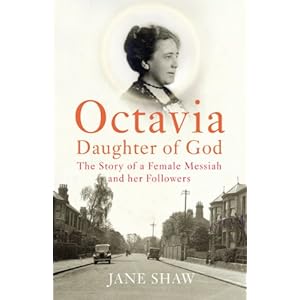
Octavia, Daughter of GodFor me this was the misprint of the week, at least: I was reading a print copy of The Week, a weekly news magazine, and found in it a review of the book Octavia, Daughter of God, which sounds like an interesting story of an early 20th century cult in Bedford, England. Actually I can’t help wondering if this Panacea Society has now become the Beaker Folk of Husborne Crawley: a matriarchal community of pedantic ex-Anglicans obsessed with doilies, and still in Bedfordshire. Or is the author Jane Shaw, a British Anglican priest who is now Dean of Grace Cathedral in San Francisco, the real Archdruid Eileen?

The review mentions how the cult’s founder, who called herself Octavia, started by recruiting “twelve female apostates”. Really? Well, these twelve were very likely apostates from the true Christian faith. But I don’t think that is what the reviewer intended. Indeed there is another review of this same book online from the Literary Review, which is extremely similar to the one in The Week but not identical – it lacks the mention of doilies. And the wording in the Literary Review is

soon Octavia had recruited twelve female apostles and many more resident members, establishing a religion with its very own Garden of Eden in the streets of Bedford.

So, female apostles, or female apostates? Or does some sub-editor not know the difference?

Someone else who might not know the difference is David Devenish, whose book Fathering Leaders, Motivating Mission is being promoted through a series of extracts on Adrian Warnock’s blog. In the extracts Devenish answers the question “Are there apostles today?”, and in one of the posts he lists among biblical apostles “Andronicus and Junias”. He repeats the name “Junias” in a later post, showing that this is not just a typo. But he shows no sign of being aware that scholars now agree that this name found in Romans 16:7 is in fact a female one, “Junia”, as in NIV 2011 and explained in a note on the verse in the NET Bible. If Devenish accepts Andronicus as an apostle (which the NET Bible does not), then he needs to accept that the woman Junia was also an apostle.

Devenish argues that there are apostles today, and I agree with him. But can there be women among them? I don’t see why not. Even if the positive example of Junia is discounted, I can see no scriptural argument against them – after all, their ministry is not one of teaching or of leading churches.

But, as I discussed last week in my post Addicted to Arguing? How to persuade others, the best way to make my point on a matter like this is to tell stories. And I have one to tell here. Recently I met an American lady who calls herself an apostle, indeed uses that as a title, Dr Rebecca Murray. Her web page says that

As a Pastor to Pastors, she operates in the apostolic and prophetic realms.

She is also co-pastor of a church in Virginia, USA. And she is a wonderful lady with a huge vision and the gifting to make it a reality. If anyone doubts whether female apostles exist today, they should meet Apostle Rebecca.

Never Say Never, says Justin Bieber

Justin Bieber: Never Say NeverI would normally have said “never” to Justin Bieber: Never Say Never. It’s certainly not a film I would have gone to the cinema to see, not least because I would have hated being surrounded by screaming teenage girls. But on a long-haul flight last week (the trip is why posting has been slow recently) I had the chance to watch this documentary about the Jesus-tattooed teen idol. And I was pleasantly surprised – not by the music and dance, which is not my style, and not by the shots of and interviews with Justin’s teen fans, but by the positive Christian message I found in the film.

It seems this was not accidental. Huffington Post reported a few months ago on how Bieber was being deliberately marketed as a “Christian icon for the tween set”. The article notes how in the film

several scenes show Bieber praying before concerts, and [his mother] Mallette discusses how God brought stability to her life as a single teenage mother.

Well, if the film gives millions of young people worldwide a positive view of the Christian faith, that is something wonderful. But I see something more in the movie, a spiritual lesson about what we can accomplish by faith if we “Never Say Never”. In the words of the film’s tagline, as Christians we need to

Find Out What’s Possible If You Never Give Up.

The basic story is a simple one (spoiler alert if you really don’t know how it ends, so far). Small town kid shows talent on the drums and singing. His mother films him and puts the results on YouTube. (These 2007 videos are on his old YouTube channel – his recent releases are on a newer channel which has now had a staggering 1.7 BILLION views.) A talent manager stumbles across his videos and is impressed enough to sign him up. He sings his way round lots of small venues to get publicity for his first album. The album goes platinum and suddenly Justin is one of the hottest properties in the world. He has a dream to fill the 20,000 seat Madison Square Garden in New York for a concert. People tell him it is impossible. But his manager goes ahead with the booking – and, as reported by Wikipedia as well as in the film, he becomes

The youngest person to ever sell out the garden. … It took 22 minutes for Justin Bieber to sell out the Garden.

Justin refused to give up and achieved his supposedly impossible dream. The film encourages us all to do the same.

So how is this a Christian message? I understand how some people might say that this is secular motivational teaching with a Christian veneer. But then a lot of secular motivational teaching is Christian preaching purged of its overtly religious material. The Christian message here is a simple one: if God has given you a dream, even one which looks impossible, and has called you to make it a reality, then step out in faith, expect his help and blessing, and don’t give up until the dream comes true.

While I have not seen this made explicit, it seems to me that Justin and his mother see his career as some kind of mission from and for God, which they are pursuing by faith. I don’t know if they know the Seven Mountains Mandate teaching which I discussed in a recent post. But Justin has shown in practice how, with the right dream and a lot of hard work, and with what some might see as luck but others as God’s blessing, it is possible even for a young outsider to get right to the peak of the arts and entertainment mountain, to use the position as a powerful Christian witness, and to bring the kingdom of God to that peak.

In the film Justin says

There’s gonna be times where people tell you that you can’t live your dreams. This is what I tell them: Never say never.

If the dreams are from God, then: Amen!