Rome earthquake prophecy causes panic

A Rome earthquake could destroy the city's famous landmarksI have written here about prophesied, or predicted, earthquakes in California, elsewhere in the USA, and in the UK. But this one is new to me: a prophecy of an earthquake in Rome, with a specific date given: 11th May 2011, today! And it has been taken seriously enough that the BBC has reported it, including the following:

special programmes have run on state TV calling for calm. … There are reports of an 18% increase in the number of city employees planning to stay away from work.

I’m not sure whether these planned absences are really enough to justify the word “panic” used in the article. Indeed I’m not sure if this even implies more extra people taking the day off than the 35,759 who have so far viewed my post about the David Wilkerson prophecy. Nevertheless it is interesting that a good number of Italians are taking the prediction seriously. A similar report in the Guardian notes that

Education officials were said to be expecting school attendances to be down by a fifth as parents decide it is better to be on the safe side.

That would certainly involve a lot of children, and parents.

The source of this prophecy is unclear. It is said that the seismologist Raffaele Bendandi, who died in 1979, predicted that 11th May 2011 would be “the day Rome would be totally destroyed” by an earthquake, the end of the so-called Eternal City. But there is no record of him having made any such earthquake prediction. No reputable scientist would be so specific so long in advance. But it seems that Bendandi was a not reputable scientist; Wikipedia, in Italian, calls him “uno pseudoscienziato italiano”, an Italian pseudo-scientist. He did predict earthquakes, with some success, but never many years in advance. The Daily Mail suggests that he made the prediction of an earthquake today as long ago as 1915, when he was 22. But actually this specific prediction seems to have originated only a few months ago.

Although the news media have used the word “prophecy” for this prediction, that doesn’t really seem appropriate. There is no indication that anyone has suggested that it has a divine or other supernatural origin. The claim is rather that someone has predicted an earthquake by scientific or pseudo-scientific methods. It is really more like a weather forecast. And as, from past experience, predicting earthquakes is even more difficult than predicting the weather, if I were in Rome I would not be unduly worried today. But then I might be careful what I did “to be on the safe side”.
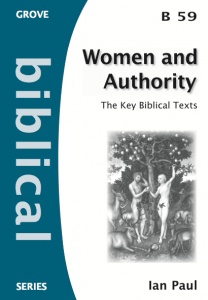
Women and Authority: new Grove booklet

Grove booklet "Women and Authority"Ian Paul has just announced:

My Grove booklet Women and Authority: the key biblical texts is now available (after a small printing hiccup!) from the Grove website.

This is the booklet whose summary I quoted in a previous post. The booklet costs £3.95, in printed form or as an e-book.

Ian is from the Church of England, but in writing this has also engaged with Roman Catholic and Free Church traditions, as well as primarily with the relevant biblical texts. He writes that while working on the booklet

I have been struck afresh by the radically egalitarian and counter-cultural nature of what Scripture says about gender, and the challenge to the church to be constantly reformed and reshaped by Scripture’s perspective, even if that means letting go of cherished traditions of interpretation.

This looks like being an excellent introduction to these issues.

Bill Hamon's California earthquake prophetic word

There has been a lot of interest here in my posts about prophecies of earthquakes in the USA. I reported that David Wilkerson prophesied one probably not in California – now easily my most popular post ever. I embedded a video of Rick Joyner discussing a prophecy by Bob Jones of an earthquake on the west coast, and quoted some similar text by Joyner. Meanwhile, as I reported, Mark Stibbe was prophesying earthquakes here in Britain.

Dr Bill HamonSo it was perhaps no surprise to find today that Dr Bill Hamon has also published a prophecy concerning a California earthquake. Hamon is well known for his prophetic ministry. But it was very interesting to read what Hamon had to say, including his principles of prophecy which start with:

We must understand that all prophecies of judgment or blessing can be postponed, lessened or cancelled even if they were God inspired.

Thus he agrees with me that Christians should not flee from California in response to the earthquake prophecies. Rather,

God wants to bring great spiritual awakening and revival to California.  If the churches and intercessors of California will pray and intercede the big earthquake will not take place in 2011.  The Church in California must get serious with God.

Hamon does predict an earthquake in California, but not as a word from God:

The Science Daily News stated in their paper April 16, 2008.  “California has more than a 99% chance of having a magnitude 6.7 or larger earthquake within the next 30 years.  The likelihood of a major quake of magnitude 7.5 or greater in the next 30 years is 46% and such a quake is most likely to occur in the southern half of the state.”  Only the prayers of the Saints can prevent it from happening.

So Hamon concludes:

My prophetic admonition to California Christians is for you to take no action based on fear, but only move by divine revelation and faith.  Jesus is your only protection and provision regardless where you are in America or anywhere in the world.  I pray for the spirit of wisdom and revelation to rest upon all Christians in California. Amen.

Amen! Also for the same spirit to rest on all Christians anywhere in the world who are in fear because of earthquake prophecies. If these words are genuine they are intended as warnings for the church to take action, not by running away but in prayer. David’s fearful wish in Psalm 55:4-8, for the wings of a dove to fly away to safety, was not right, as he realised later in the psalm:

As for me, I call to God,
and the LORD saves me. …
18 He rescues me unharmed
from the battle waged against me,
even though many oppose me.

Psalm 55:16,18 (NIV 2011)

Similarly God will protect his church in this and every spiritual battle, not by rapturing it or calling it to flee, but by making Jesus its “only protection and provision”.

One post, one event and one link change a blog

It’s amazing how one post, one event and one link can change the life and direction of a blog. That is what seems to be happening here at Gentle Wisdom.

One post: On 17th March, soon after the earthquake and tsunami in Japan and based on a link from a Facebook friend, I posted David Wilkerson prophecy: earthquakes in Japan and USA. This clearly touched a nerve, as it quickly became one of my most popular posts ever. It attracted over 800 visitors in its first four days, as I wrote in Why the fascination with prophecy?, with a peak of 526 views on 19th. For the next month this article continued to be viewed around 100 times each day for more than a month, being the most read post at Gentle Wisdom on all but about two of these days. Most of the visitors came from Google searches for “david wilkerson prophecy” and similar.

One event: Late on 27th April the news came in that David Wilkerson had been killed in a road accident. This led to an immediate surge in viewing of my post about Wilkerson’s prophecies, again mostly from the same Google search. There were 2,743 page views on 28th April, and the total page views for the site on that day, 3,692, was the second highest ever on this blog. But by 4th May the views of that post were down to 338. My post In memory of David Wilkerson was much less read, presumably because it was one of many similar ones in the blogosphere.

Jeff RenseOne link: Then suddenly on the evening of 6th May, here in England, I noticed a sudden increase in viewing figures for the blog. Indeed for several hours I was receiving around 1000 views per hour, so more than 20 times my recent average of about that number each day. And nearly all of these hits were views of the same post on David Wilkerson’s prophecies. I discovered that the reason was that two prominent links to that post had appeared on the front page of Jeff Rense’s well known site rense.com. Rense is well known, and described by Wikipedia, as “an American conspiracy theorist and radio talk-show host”. Now I welcome this link from rense.com, but please note that it came as a surprise to me and that I do not endorse the site. Anyway, because of that one link this blog received 6,790 page views on 6th May, of which 5,839 were of the David Wilkerson prophecy post, thus going well past the previous record for one day, just over 4,000 on one day in March 2008, after I linked “Benedict” with “Antichrist”. Today, 7th May, the rate of new views has dropped off, but already by lunchtime a new record has been set of over 7,000 page views.

In early April I warned Jim West that I would be threatening his #1 spot in the biblioblogger rankings. I didn’t get there in the April rankings, although I did make it into the top 50, at #47. But if my page views continue to surge as they have done recently, I will certainly be much higher in May, and Jim should at least be looking over his shoulder.

Frank Viola: evangelicalism and beyond

Frank ViolaPopular Christian author Frank Viola (his latest book is Revise Us Again) has today relaunched his blog under the new name Beyond Evangelicalism, and has started to explain the name with his post Beyond Evangelical: Part I.
Much of this post is an exploration of what evangelicalism is all about. I find it a much more satisfactory description of this movement than the flawed one (even as corrected) which I discussed in my post Does Adrian Warnock take the Bible literally? Viola explains how being Bible-centred is only one of the four main distinguishing marks of evangelicalism, and there is no mention of a requirement to interpret the Bible literally.

Viola starts by clarifying that he is an evangelical. To him, going beyond evangelicalism doesn’t mean rejecting evangelicalism. Rather, it means moving, not to the right as Adrian might want, nor to the left by following Rob Bell, but “forward”. Viola puts flesh on these bones by proposing four new characteristics of beyond-evangelicalism, not replacing but in addition to the four already recognised distinctives of evangelicalism.

One at least of these should appeal to Adrian: Viola adds to cross-centred also resurrection life-centred. I hope he would also agree with adding Christ-centred to Bible-centred. To the rather too individualistic activist-centred Viola is surely right to add as a counter-balance body life-centred. Perhaps most controversial is his addition to conversion-centred of eternal purpose-centred, but I think Viola is right to take the focus away from the currently hot issue of saving sinners from hell and putting it on the following:

God has an eternal purpose, or grand mission, that provoked Him to create. That purpose goes beyond the saving of lost souls and making the world a better place. God’s purpose transcends evangelism and social action (both of which are focused on meeting human needs). The eternal purpose is primarily by Him, through Him, and to Him. Meeting human needs is a byproduct, not the prime product.

(Note that the pairings of old and new characteristics are mine, not Viola’s.)

Viola mentions how Scot McKnight among others has described

the present crisis that evangelicalism faces and the pressing need to reshape it.

Viola’s proposals may provide just the kind of new directions needed for a reshaped evangelicalism to move beyond this crisis and take the world by storm.

Hell: comparing Rob Bell with C.S. Lewis

The Great Divorce - C.S. LewisPhil Whittall has posted an interesting review of “The Great Divorce” by C.S. Lewis, which leads into a comparison of Lewis’ view of hell with Rob Bell’s. I read The Great Divorce many years ago, and it is certainly a good read whatever one thinks of its theology. I have still not read Bell’s Love Wins, although I have read a lot about it.

It is interesting to see the hoops that some try to jump through to defend Lewis while condemning Bell. For example, Tim Keller, as quoted by Whittall, seems to accept that Bell teaches the same as Lewis, but suggests that Lewis was right to do so because he was going against the spirit of the age but Bell is wrong because he agrees with the spirit of the age. Leaving aside the question of whether this dubious assessment is correct, does Keller really mean to claim that whether a teaching is right or wrong depends on the spirit of the age, not on whether it agrees with biblical truth?

Whittall’s conclusions are interesting. They are basically that Bell and Lewis are teaching the same thing, that there will be chances after death for those in hell to repent and go to heaven. The main difference between the two is that Bell expects that most, or perhaps all, will take these chances, whereas Lewis expected very few to do so.

I am not at all sure about this teaching about another chance to repent. I don’t see any biblical warrant for it. But I don’t see it clearly ruled out in the Bible either, so I am open to being convinced. But I think my expectation would be more like Lewis’ than Bell’s, at least concerning those who had heard the gospel in this life. As for those who never heard it, they are not Lewis’ focus, and I haven’t read what, if anything, Bell has to say about how they might be saved.

Does Adrian Warnock take the Bible literally?

I had intended to drop the issue of Adrian Warnock versus Rob Bell. But Adrian’s latest post Is Rob Bell a neo-liberal who does not take the Bible literally? goes into a lot more detail about why he refuses to accept Bell as an evangelical. As such it reads a bit like a response to my post Rob Bell, Adrian Warnock and limits of evangelicalism, although it does not mention what I wrote.

It is really interesting to see what Adrian considers to disqualify someone from being an evangelical. One of them seems to be speaking to ordinary people and observing the world, and then allowing that to inform one’s theology. Another is to ask questions. Of course Jesus based much of his teaching on what he observed in the world and from ordinary people, and asked lots of questions. Is Rob Bell wrong to follow the same methods?

Perhaps most telling is the apparent claim in the title of his post that anyone who “does not take the Bible literally” is not an evangelical but a “neo-liberal”. More specifically, Adrian’s charge against Rob Bell is that

he no longer takes the Bible literally whenever it is possible to do so.

The problem with this argument is that no evangelical, indeed no one as far as I know, actually takes the Bible literally, even with the qualification “whenever it is possible to do so”. I made this point in one of the first blog posts I ever wrote, at Better Bibles Blog in 2005, Does God have a long nose? Pinocchio by Enrico MazzantiSee also the related post, here at Gentle Wisdom in 2008, Love takes a long thyme, in which I also wrote about

the Pinocchio approach to Scripture: the more you misrepresent it, the longer your nose and so the greater your love!

Well, I am not seriously accusing anyone of that. But I do claim, as explained in those posts, that anyone who does not believe that God has a long nose, literally, does not take literally the whole Bible in its original language texts. This is the clear teaching of Exodus 34:6 in the Hebrew, and it is possible to take it literally, at least as a description of the body of Jesus, God become flesh. Does anyone do so? Not as far as I know. Not even Adrian himself takes the Bible literally. That means that on his definition there are probably no evangelicals at all, and we should all be described with Rob Bell as “neo-liberals”.

Another example: the biblical word for “hell” as place of punishment is literally Gehenna, the name of a specific and literal valley outside the walls of Jerusalem. As it is quite possible to take this literally, why don’t “Reformed” evangelicals teach that their place of “eternal conscious punishment” is physically located in that valley?

So, the real issue between different evangelicals is which parts of the Bible they take literally. But where does one draw the line? And what exactly does it mean to take the Bible literally?

Surely it is better to accept the current standard definitions of evangelicalism, such as the British Evangelical Alliance Basis of Faith and the American Statement of Faith of the National Association of Evangelicals. In these the Bible is described as inspired by God, as authoritative for believers, and in some cases as infallible or inerrant. But these statements do not prescribe that it must always be taken literally, no doubt because the good evangelical scholars who prepared them recognise that this is impossible.

Tomorrow, vote Yes! to fairer votes

YES to Fairer VotesI don’t often on this blog clearly endorse one side of a political debate. But I have already nailed my colours to the mast on tomorrow’s UK referendum on the Alternative Vote. See my argument from Christian principles for a Yes! vote; my endorsement of Ekklesia’s Yes! campaign; and, most explicitly, my response to Doug Chaplin’s No! arguments.

I have nothing more to add to the debate except to express my disappointment that the campaign has been so focused on personalities, and often so negative. While the principles I put forward in my post Touch not the Lord’s anointed apply in detail only to Christians, I wish they could be applied also to political leaders. Or perhaps they can, as we are talking about ministers and Privy Councillors of a queen who was anointed in God’s name at her coronation. But there are some complex theological and political issues there which I don’t want to go into now.

So let me simply urge my UK readers to go out and vote, at any time from 7.00 am to 10.00 pm tomorrow, and to vote Yes! to fairer votes.

Rob Bell, Adrian Warnock and limits of evangelicalism

Before I completely leave behind the debate between Rob Bell and Adrian Warnock, I want to share some thoughts on what this issue can tell us about the limits of evangelicalism.

Premier Christian Radio: The 'Heaven and Hell' DebateThe full debate is available as an online video, courtesy of Premier Christian Radio. This post is based on an extract from it posted on YouTube and also on Adrian’s blog, in a post where he asks, Has Rob Bell demonstrated clearly that he is not an Evangelical any more?, and answers his question with

because [Bell] has a very different approach to the Bible, it is hard to accept him as an Evangelical.

Here is part of that extract from the debate:

AW: To my mind, even in our interview today, you seem to have cast doubt on a very literal interpretation of certain Bible passages, and to me, that causes me problems in recognising you as an evangelical.

RB: … The book is my attempt to be true to the Scriptures and … to give this story its proper due, and to highlight perhaps things that are sitting right there in the text that people haven’t heard. So the idea that somehow I’m dismissing the Scriptures, then why do I spend so much time trying to get out what they really say?

AW: I never said you were dismissing them. I said you had a different approach to them.

But is Bell’s approach to the Scriptures really so different from the standard evangelical one? Or is the issue more with the conclusions that he comes to from it?

A major problem with the whole evangelical enterprise is that the Bible cannot be interpreted for life today without bringing to the text a whole range of presuppositions. Traditional “Reformed” evangelicals bring one set of presuppositions. Adrian brings a slightly different set. I bring yet another set. And then Rob Bell brings his own presuppositions. As evangelicals each of us interprets the Bible using more or less the same principles, but each comes to a different set of answers. The difference between those answers is not because some of us are rejecting the authority of the Bible, nor even for the most part with our approach in interpreting it, but because of our different presuppositions.

Now the “Reformed” camp may want to limit evangelicalism to certain sets of acceptable presuppositions and conclusions, perhaps only the ones Adrian describes as “a very literal interpretation”. Thereby they would exclude Rob Bell, and perhaps myself. Some of them might even exclude Adrian, for example because he accepts the charismatic gifts. But if the definition of an evangelical is someone who accepts the Bible as the inspired word of God, then it certainly includes those like Rob Bell who come to non-standard conclusions from those Scriptures.

I am very glad that at least here in England evangelicalism is quite broad, broad enough to include people like Rob Bell, and myself, who do not always follow the traditions of interpreting the Bible. After all, one of the essential characteristics of evangelicalism is that it puts the Scriptures above human traditions, which include traditional methods of interpretation and traditional conclusions. Therefore I resent the attempts of some, such as Adrian, to exclude from the evangelical camp those who do not follow the tradition which he reveres. The camp can and should be broad enough to include Bell and myself as well as Adrian and his heroes.

Ever feel like a hypocrite?

Martin TrenchA few weeks ago I rather briefly met Martin Trench, who was a visiting speaker at my church. Martin is a Scotsman who is now a “Lead Pastor” in Edmonton, Alberta, Canada, and he writes a blog Thinking Aloud, at his church’s website. He is therefore a neighbour of another British-born blogger pastor I follow, Tim Chesterton, now blogging at Faith, Folk and Charity. Perhaps this post will serve to introduce these two.

Probably Martin’s greatest claim to fame, which I mentioned in a comment here, is that he is the co-author of a book Victorious Eschatology: A Partial Preterist View which managed to convince Peter Wagner to change his views on the end times.

Martin’s post today, Ever feel like a hypocrite?, may not have the same far-reaching effect, but it certainly had an effect on me, especially in the light of my posts about Rob Bell’s alleged blasphemy and about not touching the Lord’s anointed. Martin opens his post with “I do”, to the question in the title. Here are parts of how he continues, with his original emphasis:

I do not like to see people judging other people, and I tend to be pretty free from judgmental attitudes myself …….. with one exception. I tend to judge judgmental people. I know it sounds ludicrous, but I tend to judge their level of Christianity by the fact that they go about judging other people’s Christianity. …

I don’t get into theological debates with people whose minds are closed …. with one exception. I just can’t seem to help getting into debates with people in order to inform them that getting into debates is a waste of time!

I know that it sounds self-righteous of me, but I can’t stand seeing or hearing people being self-righteous.

But, none of that brings me any happiness or peace. I don’t feel better after “sorting out” a nasty, judgmental, hater – because I know that it hasn’t made any difference to them. I should really feel compassion for them, because (no matter how popular or famous or widely quoted they are) if they have a closed mind and refuse to ever see the possibility that there may be merit in another point of view, and if they have to defend their point of view by attacking other people, then I can only conclude that they are an un-evolved soul … Maybe even that’s judgmental, but I can remember when my faith was as stunted and withered as that, and I eventually grew beyond that. …

So, for my own happiness, I am now trying to avoid pointing out to haters and judgers and heresy-hunters and debaters that they may be missing the point of what Jesus was all about. I am going to let it go and not even read their posts.

In these attitudes I think I am very like Martin. It is very sensible of him to let these things go, especially as a busy pastor. I really should do the same. So if you don’t read anything more here about Rob Bell and Adrian Warnock, don’t take it that I have changed my mind and agree with Adrian. I have just decided to back off, for my own happiness, and also to avoid being seen as a hypocrite for criticising people like Adrian when I have condemned denouncing one’s Christian brothers and sisters.