Why is Easter so late this year?

A Roman Period tomb with a rolling stoneEarly in 2008 I asked Why is Easter so early this year? That year Easter fell on 23rd March, one day later than the earliest possible date according to the current calendar. This year, 2011, it is more than a month later, on 24th April, one day earlier than the latest possible date. It will not fall on that latest date until 2038, and the previous time was 1943. So this may be the latest Easter in my lifetime.

The basic reason for the late Easter is that its date is tied to the phases of the moon. As I wrote in 2008, the dates each year, as recognised by the western churches,

are determined by complex calculations which go back to the 6th century: Easter is the Sunday after the first full moon on or after 21st March, supposed to be the day of the spring equinox.

This year the relevant full moon dates are Saturday 19th March and Monday 18th April. The former was before the spring equinox, so the Easter full moon is on 18th April – and the Easter celebrations have to wait nearly a full week until the following Sunday.

This late Easter is again causing difficulties with school holidays, at least here in the UK. Here in Warrington the holidays are finishing this weekend, and then children are back at school for less than a week before their four day Easter break. But a friend living here who is a teacher in a nearby borough only starts her school holidays today, because that area has chosen to tie its holidays to Easter. That would be very difficult for her if she had children at school in Warrington.

Another undesirable side effect of this late Easter, again in the UK, is that it falls only one week before the May Day bank holiday weekend. This year the situation is made even worse by the extra royal wedding bank holiday on 29th April. This leaves only three working days between two four day breaks. It is hardly surprising that some companies, e.g. Toyota, have taken the opportunity to close down for those three days and take a break for nearly two weeks. That is not a good way to stimulate our struggling economy.

Meanwhile Ekklesia reports that Work continues for a common date for Easter:

The General Secretary of the World Council of Churches has urged Christians to give this year’s celebration of Easter a clear ecumenical profile and to work for a common date of Easter for the future, noting that this year it falls on the same day 24 April for both eastern and western traditions.

“In a world divided by poverty and violence, it is important that we are one in our witness to the crucified and risen Christ in actions as well as in words,” said the Rev Dr Olav Fykse Tveit.

As is clear from another Ekklesia article, it seems that the problem is with getting agreement from the Orthodox churches. In principle, it seems, they are happy to move to a common date, although they would prefer a moveable date to a fixed one. But in the politically and religiously volatile environment of eastern Europe it is difficult to get these churches to come to a formal agreement on anything.

We can only hope and pray that eventually churches will agree on a common date which makes sense for everyone – and enjoy our break at the end of this month.

Literal Bible translations: crutches for bad teachers?

ESV BibleT.C. Robinson, at New Leaven, quoted Daniel Doleys writing about why he moved back to teaching from the ESV Bible. I was being a bit mischievous when I commented:

This guy is simply showing that he doesn’t understand how language work[s] and doesn’t understand the ESV. … I’m sorry to say this, but by returning to ESV Daniel is simply helping himself continue to teach and preach badly.

Of course I didn’t write anything like this without explaining my reasons, which I have omitted in the quotation above. And in a further exchange of comments with Daniel I accepted that the example he had given was not really one of bad teaching.

Nevertheless, I would claim that literal Bible translations like the ESV are often used as crutches by bad preachers and Christian teachers.

First I need to explain what I mean by “literal Bible translations”. Henry Neufeld has rightly objected to a misuse of the word “literal”. As this word is so often abused it might be better not to apply it to Bible versions, and use the more technical term “formal equivalence translation”. But that would confuse many people – and make the title of this post too long.

Anyway, I am referring here to versions at one end of the translation spectrum: ESV, NASB, RSV, KJV, NKJV and some others which are classified as more or less “literal” or “formal equivalence”. The Good News Bible, CEV and NLT are among those at the other end of the spectrum, “meaning-based” or “dynamic equivalence”. NIV is somewhere in the middle.

Now I certainly don’t want to claim that all preachers and teachers who use literal translations are bad. Some of the very best preachers use versions of this type. But there are also many bad preachers and teachers out there. And many, not all, of them prefer literal translations. There are at least two reasons why:

First, preachers can simply explain the passage and pretend they have preached a sermon. Sadly it is common for pastors, especially less well educated ones, to reject meaning-based Bible translations because they would be left with nothing to say. These preachers have been used to reading a Bible passage from a version which their congregation does not understand clearly, because it is written in unnatural and perhaps old-fashioned language, and then spending a long time explaining its meaning. Maybe this is all there is to the sermon, or there is only a token attempt to apply it to the hearers’ situation. But if the meaning is clear when the passage is read from the Bible, as it surely should be, then there is little or nothing left for the preacher to say.

Second, and this is what I was getting at in my response to the New Leaven post, literal Bible translations encourage teachers to focus on unimportant details while missing the broader flow of the text. Daniel Doleys’ example about the phrase “in the eyes” in Judges can serve as an example here. Daniel complained that NIV was inconsistent in its translation of this phrase – but seemed to have failed to notice that his preferred ESV is also inconsistent. But should such phrases be translated consistently? If the meaning and context is the same, preferably yes. But part of the argument for literal translations is that each word in the original language should be translated consistently even when the meanings and contexts are different. Some bad teachers want this because they love to discuss how specific words are used with some kind of semi-mystical meaning through the Bible or a part of it – without taking into account that these words are perfectly ordinary ones like “eyes” used in many different ways.

Now I accept that there is a place for looking in detail at how each original language word is used in different senses and contexts within the biblical texts. But this kind of study should be done from the original language texts, and the results should be shared among biblical scholars. Only bad preachers try to impress their regular Sunday congregations with insights of this kind, supposedly based on an original language word but often in fact mainly derived from translations and concordances in English, or whatever else their mother tongue might be.

So it is perhaps not surprising that most ordinary congregation members prefer meaning-based translations while their pastors try to persuade them to use more literal ones. After all, the pastors don’t want their flocks to understand the passage too clearly, or they might feel redundant!

What is the answer here? Preachers and teachers need to realise that there is much more to a good sermon than exegesis, explaining the meaning of the text. They may have to do that, of course, whatever translation they are using, but they should make that task as simple as possible by using a clear and natural Bible version. They should also realise that finding themes and connections between texts, while fascinating for scholars, is rarely helpful for general congregations. The heart of a good expository sermon must always be applying the Bible passage to the needs of the hearers. And the best translation to use is the one which makes that task most effective.

Is the Smith Wigglesworth revival prophecy genuine?

Smith Wigglesworth preachingAt the end of my post yesterday about Smith Wigglesworth delivering people from smoking in the name of Jesus, I mentioned Wigglesworth’s 1947 prophecy of revival in the UK, which I had discussed at more length in a 2007 post. But today a reader of Gentle Wisdom suggested to me that this prophecy might not be genuine. And it turns out that he may well be correct.

Here, for easy reference, is the text of the prophecy, as published by Adrian Warnock:

THE GREAT REVIVAL

“During the next few decades there will be two distinct moves of the Holy Spirit across the Church in Great Britain. The first move will affect every church that is open to receive it and will be characterised by a restoration of the baptism and gifts of the Holy Spirit.

The second move of the Holy Spirit will result in people leaving historic churches and planting new churches.

In the duration of each of these moves, the people who are involved will say, ‘This is the great revival.’ But the Lord says, ‘No, neither is this the great revival, but both are steps towards it.’

When the new church phase is on the wane, there will be evidenced in the churches something that has not been seen before: a coming together of those with an emphasis on the Word and those with an emphasis on the Spirit. When the Word and the Spirit come together, there will be the biggest movement of the Holy Spirit that the nation, and indeed, the world, has ever seen. It will mark the beginning of a revival that will eclipse anything that has been witnessed within these shores, even the Wesleyan and the Welsh revivals of former years. The outpouring of God’s Spirit will flow over from the United Kingdom to the mainland of Europe, and from there, will begin a missionary move to the ends of the earth.”

— Smith Wigglesworth, 1947

As I previously posted in a comment, I have found out, at this site among others, that “This prophecy was given at the annual Elim conference in 1947″, so it is said. This was presumably the conference of the Elim Pentecostal Church, but I can’t find anything more about it, including its exact date. The date is important because Wigglesworth died on 12th March 1947, age 87, but he was active until the end and so could have given this prophecy in his final weeks. Indeed an article found in several places on the Internet (this is apparently the earliest version) suggests that he gave it a week before his death, but this needs confirmation.

A few years earlier Wigglesworth had given a somewhat similar but personal prophecy to David du Plessis. But there is no mention of the 1947 prophecy at the Smith Wigglesworth website, and according to an Amazon review by Phil Stanton this word is not included in Smith Wigglesworth: The Complete Collection of His Life Teachings compiled by Roberts Liardon. This evidence indeed casts some doubt on its authenticity.

I must say I wonder if the prophecy is a genuine one from 1947 but not actually given through Wigglesworth. The prophecy has certainly been around for quite a number of years. With the help of Google Books I can trace references to it back to 1999. But personally I can remember hearing about it many years before that, probably in the 1980s.

Does anyone reading this have any more information about the origin of this prophecy or its first publication?

Benny Hinn: divorced and still ministering

Benny HinnA lot of people come to this blog searching for information about Benny Hinn’s divorce. They probably find my post reporting on Hinn’s “broken heart” at the ending of his marriage. They may also find this post and this one. But all of these are over a year old. What has been happening with him since then?

Well, Benny is still keeping up a busy schedule of ministry, as listed at his official website. It doesn’t seem to include as many international events as it did a few years ago. Indeed his visit to London, announced for 24th and 25th June, looks like his only one of the year outside North America, apart from his Holy Land tour in November. It may simply be that at nearly 60 his age is catching up with him.

Meanwhile the Hinns’ divorce has been finalised, as confirmed by Bene Diction.

Last August the Christian Post reported that Benny Hinn Says Neglecting Family Led to Divorce, quoting Hinn as saying:

I’ve made mistakes because I wasn’t the perfect husband and the perfect dad because I was always gone traveling the world. That’s probably what broke the whole thing up.

This is just as I had surmised in March.

The Christian Post article also mentions allegations in the National Enquirer that Hinn had an affair with fellow evangelist Paula White. Wikipedia also mentions these allegations. Hinn and White denied them. The latest development, reported by the Christianity Today blog, is that

Benny Hinn is being sued by Strang Communications, a publishing company that alleges that Hinn violated a morality clause in their contract when he began an “inappropriate relationship” with Without Walls pastor Paula White.

Hinn has admitted concerning his friendship with White that

while it has remained morally pure at all times, I have enjoyed the company of someone who has also gone through the trauma of a painful and public divorce.

And they were photographed holding hands:Benny Hinn and Paula White

It is typical of the gutter press to assume that two people who hold hands are having a “torrid affair”, and not just showing friendship. As Christians we certainly should not jump to such conclusions, but should accept Hinn’s statement that the friendship “remained morally pure at all times”. We are instructed in the Bible:

Do not entertain an accusation against an elder unless it is brought by two or three witnesses.

1 Timothy 5:19 (NIV 2011)

Since there is only one witness, that should be the end of the matter, including for the Christian publishers Strang Communications unless of course they have other evidence.

Gagarin's God: found not in space but on earth

Yuri Gagarin (first day cover)Today the world celebrates fifty years since Yuri Gagarin became the first man in space. He was an unlikely hero. Although a highly trained pilot, as the BBC reports, he

had no control over his spacecraft during the historic flight.

And he didn’t even complete a full orbit of the earth.

But what did he see, or not see, in space? And what did he say, or not say? It became a staple theme of atheistic Soviet propaganda that during his flight he said

I see no God up here.

But no such words appear in the official transcripts of his communications. A few days later he did apparently say, in response to a question very likely from an important communist,

No I didn’t see God. I looked and looked but I didn’t see God.

On the other hand he also said, at least as reported at Wikipedia,

Someone who never met God on Earth, would never meet Him in space.

And it is known that he was a practising Orthodox Christian who had his daughter baptised shortly before his flight.

Of course Gagarin did not see God in space. He clearly understood well that God is not an old man sitting in the sky, hidden from human view only by the atmosphere. It is probably a reflection of the naivety of the Soviet propaganda machine, rather than of the naivety of the popular Russian idea of God, that Gagarin’s alleged words were ever considered a serious argument for atheism. As even their famous peasant become cosmonaut clearly understood, God is to be found not in space but here on earth.

Piper: Abused women should seek help from the church

John PiperSeveral bloggers, including Henry Neufeld, have linked to a short YouTube video by John Piper entitled Does a women [sic] submit to abuse? I must say I wasn’t quite as shocked as I thought I might be from some of the comments I had seen. I can accept that a woman who has committed herself to a man in marriage should endure some difficulties including minor abuse without walking out on him – and exactly the same for a man who has committed himself to his wife. I am not saying that either should endure life-threatening abuse, or submit to being required to sin, but then neither is Piper.

Piper has wise advice in the last part of the video (starting at 2:36):

If it’s not requiring her to sin but simply hurting her, then I think she endures verbal abuse for a season, and she endures perhaps being smacked one night, and then she seeks help from the church. Every time I deal with somebody in this I find the ultimate solution under God in the church, where the words “This man should be disciplined, this man should be disciplined” … She should have a safe place in the body of Christ where she goes and where the people in the church deal with it. She can’t deal with it by herself.

So the short answer I think is, the church is really crucial here, to step in, be her strength, say to this man “You can’t do this. You cannot do this. That’s not what we allow. That’s not what Christ calls you to be.” So, I can’t go into all the details, but I would say “I hope …” I would say to a woman “Come to a church that you feel safe in. Tell them the case. Let the leaders step in and help you navigate the difficulties here.”

These are good words in principle. The problem is, what if the abused woman does not feel safe in the church that she and her husband attend? What if, as Henry suggests, the abusive husband is himself one of the leaders of the church? This certainly happens. What if the church doesn’t believe her? This also certainly happens. What if the woman is so badly hurt that she cannot trust any man, and the church leadership is all male as Piper would expect?

Does Piper mean to suggest that the woman should go to the leaders of a different church? That is not bad advice – I would hope that most churches would be prepared to help and protect a woman in those circumstances. The problem is that that church would have no authority over the husband to discipline him and bring about a proper resolution. And it would still cause serious issues if the husband is church leader well known in the area.

Would the right thing for the woman be to report the matter to the authorities, as Henry suggests? In 1 Corinthians 6:1-8 Paul strongly warns believers not to take disputes between them to secular authorities. It would certainly be best if the church could deal with the matter internally, at least unless the case is so serious that the police would expect to be involved. If the church is unwilling or unable to resolve the matter, I think the abused woman would be right to look elsewhere for help. But that implies that the church is seriously failing to live up to its obligations towards its members.

How to quit smoking, in the Name of Jesus

Smith WigglesworthI came across an interesting snippet about how to quit smoking through the name of Jesus, – or perhaps more accurately, how to get others to quit through this name. These words are from a report written in 1915 by the famous Pentecostal evangelist and healer Smith Wigglesworth, on his 1914 ministry trip all around the USA and Canada. The snippet is interesting partly because it reveals an understanding of evil smoking is, from long before it was recognised as a major cause of cancer.

Wigglesworth writes:

A young man came to me to be delivered from nicotine poisoning through cigarettes which was wrecking his nerves, and he had tried all means to be free. By faith I cast out this evil power in the Name of Jesus. Oh, if we knew the power of the Name, what it means, and how God intends to honour the simple faith in the Name.

Millions around the world are still trapped by smoking, knowing that it is ruining their health and wanting to give up, but unable to do so. Neither human willpower nor chemical remedies can help many of these people. But Wigglesworth named this trap for what it is, an evil power, and invoked the name of Jesus. He alone has the power to deliver anyone from this and every other power of evil and bring them into the freedom of new life following him.

Smith Wigglesworth's own picture: leaving New York

Smith Wigglesworth's own picture: leaving New York

It was many years later that this same Smith Wigglesworth gave the prophecy which I previously discussed on this blog.

Woman bishop murdered in Oxford

A visiting American woman bishop was found dead at a picnic spot by the river Cherwell in Oxford. Beside her was an empty bottle of wine which had been poisoned. Passing punters had seen her there with a mysterious hooded figure, believed to be a friar. She had been at a colloquium in a college run by these friars, some of whom were traditionalist Roman Catholics. Could this have been direct action against women in ministry?

Lewis (TV series) - Wikipedia, the free encyclopediaThis was the first part of the plot of last night’s episode of the TV show Lewis, a spin-off from the Inspector Morse series also set in Oxford. Matters then got much more complicated, with more deaths. I won’t give away more of the plot because the programme can be viewed on ITV Player (maybe only in the UK, but for 29 more days – more generous than BBC iPlayer). Don’t worry about the over 18 classification for late evening content as this only

Contains one moderate scene of threat and some mild images of crime aftermath.

It was tame compared with CSI. And it was a good Sunday evening’s viewing, although not an in depth exploration of the issues about women bishops.

New papyrus may be one of earliest New Testament texts

Tommy Wasserman of Evangelical Textual Criticism writes that an early manuscript of the book of Hebrews has been discovered. He quotes Brian Small writing about

a newly-discovered (three weeks ago!) papyrus fragment containing a portion of Hebrews 11. It was discovered in a funerary mask and is dated to the second century!

Small apparently wrote this on his blog Polumeros kai Polutropos but then deleted his post – still available as a Google cache. Probably the deletion is related to the accusations made against Small in comments on Wasserman’s post by someone who is not prepared to give their name. My policy is to ignore anonymous accusations as irresponsible gossip.

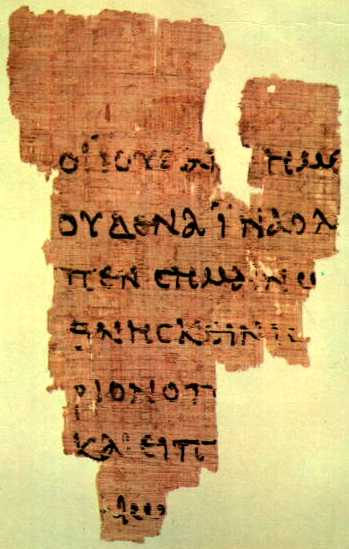
P52 recto: John 18:31-33 (2nd century)The discovery is apparently among the collection described by Dr Scott Carroll as “some of the earliest biblical texts known to-date”. I think he means New Testament texts, as these are certainly later than the Dead Sea Scrolls which include much of the Hebrew Bible. But no images are available of this new discovery – the image I am showing here is of a different second century New Testament papyrus fragment.

Wasserman is careful in what he says about these discoveries:

we have to be extremely cautious about the claimed second-century date. …  of course there is … a real danger to through out sensational claims about “earliest biblical texts known to-date,” etc (which media just loves).

Well, I’m sure he is right to distrust the media, as I do, especially in the wake of the fiasco of the forged ancient lead books. But if this fragment is indeed as old as is claimed, while it will not exactly be “the major discovery of Christian history” as was claimed for the lead books, it could be the discovery of the year or even of the decade in terms of confirming the antiquity of the New Testament text.

Bob Jones: Flee California! But should Christians run?

A few weeks ago I wrote of how Rick Joyner was reminding the world of a prophecy by Bob Jones, that a major earthquake in Japan would be followed by one on the west coast of the USA. This prophecy has been getting a lot of attention in certain circles – and bringing a lot of traffic to this blog.

On this subject, a Facebook friend sent me a link to a Note by Shawn Bolz: MORE PERSPECTIVE ON EARTHQUAKES AND PROPHECIES ON WEST COAST the words of Bob Jones & Rick Joyner. This link may work only for Facebook members, but more or less the same material appears as a post on Bolz’s blog. According to his endorsement at Rick Joyner’s MorningStar website,

Shawn Bolz has ministered with a catalytic prophetic anointing for over a decade. … He is currently working on television and movie projects and resides in Hollywood, California.

Jan. 17, 1994: the covered body of Los Angeles motorcycle officer Clarence W. Dean lays near his motorcycle which plunged off Highway 14 overpass that collapsed onto Interstate 5 (AP Photo/Doug Pizac)In the Facebook note Bolz writes that

the prophecies about California and the west coast having an Earthquake and nuclear melt down are all the buzz right now … I have never heard Bob [Jones] so adamant about words before,he has actually told people to move away from California and the west coast.

However,

I love Rick Joyner and I adore Bob Jones, but I want to give a different perspective. …

About the Earthquake and Nuclear fallout: God has not been speaking to anyone I know in California about this theme for now. No one IN California or the west coast is getting these words on a level to suggest to people to actually move away.

Actually, according to Joyner, Jones prophesied an economic meltdown, not a nuclear one, but given recent nuclear events in Japan I’m not surprised the two ideas have become confused.

Bolz makes some good points about prophecy and how it works, including:

God always has an army in the hardest places: Those of you who know you are supposed to be here, you are the army of the Kingdom who can help if something terrible does happen.

He wisely concludes:

I am not scared and I don’t feel I need to heed their warnings to move except to pray my guts out but I love them. Everyone has to decide for themselves. Again these are not promises from God they are potentials. We are Christians and we have to exercise power over the storms.

These are important principles. As I argued before, God is not going to take Christians away from difficult times on this earth in a Rapture. In the same way, Christians should not flee from impending disasters, unless specifically and personally told to do so, but should stay put, to pray that God will relent, to take authority over the threat in Jesus’ name, and to be available to help if the worst does happen.