My blogroll was woefully inadequate. I have now replaced it with a set of links selected and imported from Google Reader. These are most of the blogs I read which are updated fairly regular and which I think are of general interest to my readers. If anyone thinks they have been omitted by mistake, they can ask to be added, but I make no promises to do so.
Monthly Archives: May 2011
The Last Trump
No, I’m not predicting that the one announcing the end of the world will sound this Saturday:
We shall not all sleep, but we shall all be changed, 52 In a moment, in the twinkling of an eye, at the last trump: for the trumpet shall sound, and the dead shall be raised incorruptible, and we shall be changed.
1 Corinthians 15:51-52 (KJV)
Donald Trump is not running for President. So we may have heard the last of Trump here in the UK, even if he continues as a US TV celebrity. As Mark Mardell of the BBC writes:
President Trump had such a ring to it, conjuring images of a blunt, irascible leader. A joy to headline writers: The Last Trump. Diamonds are Trump’s.
But we can no longer even fantasise about Donald Trump in the Oval Office.
The lunatic fringe will not be represented in the Republican race. I am, of course, talking about his hair, not his politics.
In the words of the BBC news front page, this is indeed a “disappointing blow to the world’s headline writers”. I can’t help thinking it is also a blow to President Obama: if the Republicans had selected such an opponent, he could hardly have avoid winning again next year. Even if enough diamonds had been Trump’s, not enough hearts would ever be Trump’s.
Thinking in Reality on Hell and Resurrection
The flames of the great debate on hell seem to be burning low. So, lest they are extinguished, and Rob Bell’s roasting by fundamentalists proves less than the eternal punishment they think he deserves, here is an attempt to stoke up the fire again, although not against Bell…
I just discovered the rather occasional blog Thinking in Reality, by the anonymous male Iam4Jesus. The first link I followed was to a new post Are Atheists Right About Bible Prophecy? I don’t have anything to say just at the moment about Harold Camping’s prediction of the Rapture this Saturday, beyond my general scepticism about the Rapture. But I was attracted by the title of one of the other posts at Thinking in Reality, Are there immortal worms in hell?
It turns out that this post is part of a 2009 series on hell at Thinking in Reality. And there is certainly reality in the thinking I found there. The series starts with a post Where are we going…and why are we in this hand basket? asking
Will a Loving God Punish People Forever in Hell?
and noting that the biblical answer is not exactly what many people think:
Romans 6:23 where it says, the wages of sin is death. It does not say – the wages of sin is eternal suffering….
The very idea of this Hell – eternal suffering – is actually what drives many highly intelligent people away from Christ and His love. They say that they can’t beleive in a God who would be so terribly horrific. In fact Charles Darwin, in his autobiography, wrote: “Thus disbelief crept over me at a very slow rate, but was at last complete . . . I can indeed hardly see how anyone ought to wish Christianity to be true; for if so, the plain language of the text seems to show that the men who do not believe . . . will be everlastingly punished. And this is a damnable doctrine”
I think, the problem is not that the Bible teaches this “damnable doctrine” but that men have misunderstood what the Bible actually says.
Indeed, and some women have also misunderstood it.
In the second post in the series Iam4Jesus offers A Brief History of Hell. He mentions the place of Dante’s Divine Comedy in the development of the idea, and notes that
The popular concept of hell is a mixture of small bits of Bible truth combined with pagan ideas and human imagination. … One of the reasons this concept of hell survived is because theologians believed the teaching deterred people from evil.
I will pass over part 3 to part 4, the aforementioned Are there immortal worms in hell? Here the author explains the meaning of Gehenna, the word Jesus used to refer to hell:
With the understanding that Gehenna is what it is (an acursed trash pile), we can begin to ascertain that He means simply the fire will burn until the bodies of the wicked are consumed.
The last main post in the series by Iam4Jesus is The Destruction of Soul and Body in Hell. Here he anchors his main argument in Matthew 10:28:
Jesus here explains that, when one man kills another, the resulting death is only temporary because God can raise the dead to life again. But, when God destroys one in hell (Gehenna), the resulting death is eternal. There is no resurrection from this fate, which the Bible calls “the second death.”
… the wicked will be destroyed. They will not live for eternity in another place or state of everlasting anguish. They will reap their destruction in the lake of fire at the end of the age. They will be consumed virtually instantaneously by the heat of the fire and will never live again.
There is a lot more here, which I can only agree with. It is good that after a few follow-up posts Iam4Jesus moves on to the more positive topic of The Resurrection(s). And here he puts forward an interesting and surely controversial suggestion. Referring to the second, post-millennium resurrection of Revelation 20:4a, he writes:
That same verse explains, “The rest of the dead did not come to life until the thousand years were completed.” In this resurrection will others have the opportunity to receive salvation? I believe, they will be called to understand God’s truth and His plan during a period sometimes referred to as the “great white throne” judgment (verse 11). …
Those resurrected in this group have never completely understood the truth of God’s plan for Grace and Mercy that He has designed and instituted from before the beginning of time. Once we realize that the majority of all people who have ever lived have never heard God’s truth, this resurrection offers some clarity and hope to these. Rather than such people being condemned to eternal suffering, the truth of the Bible is much more comforting and encouraging. I believe that God will extend the opportunity for eternal life to everyone, possibly relatively few in this age but to billions of people in the coming second resurrection.
Now I am by no means sure that Iam4Jesus is correct on every point in his discussion. But he seems to have put forward strong arguments for two points, that hell consists of annihilation rather than eternal torment, and that there will be a second chance after death at least for those who have not clearly heard the gospel in this life. Despite the protestations of the Reformed camp, the Bible does not unambiguously teach the “damnable doctrine” rejected by Darwin.
Iam4Jesus does not say what Rob Bell seems to, that “Love Wins” to the extent that all will be saved. But he does say that God will give a fair chance to all to accept his salvation, and that the alternative is not horrific eternal torment but quick destruction by fire. I think I agree.
I too am a communist (with a small "c")
My Christian friend and former colleague Michael has blogged from Moscow a post I am a communist. The small “c” even in the title is not accidental, even though Michael illustrates his post with pictures of Soviet achievements – “ВДНХ” is the Exhibition of Achievements of the National Economy, the one-time showpiece of the USSR now officially known as the All-Russia Exhibition Centre. For Michael makes it very clear that he is no sympathiser with Soviet Communism. He is especially critical of how it was based on violence and coercion. And concerning its atheistic basis, he asks:
why did the soviets throw God out? Didn’t they realize that God is on the side of the poor, the upholder of the weak, oppressed and downtrodden. Why didn’t they enlist his support in their strivings for justice and equality? Well, unfortunately the church had sided with the oppressor. …
So in what sense can Michael call himself a communist? He explains:
I am a communist. I embrace the goal, the impact statement of a just and equal society for all. But I do not espouse the route the soviets took. If change is not peaceful the oppressed simply become the oppressor – and that is what happened. … Those who are opposed to the new society – love them. Melt them with the warmth of the sun; blowing a howling gale around them will just make them cling to their opposition more tightly. But as I look at those communist ideals, they resonate with me. Thy Kingdom come, thy will be done on earth just as it is in heaven.
In this I agree with Michael. So I can say that I too am a communist, with a small “c”. I embrace the ideal which the early church found:
All the believers were one in heart and mind. No one claimed that any of their possessions was their own, but they shared everything they had. 33 … God’s grace was so powerfully at work in them all 34 that there were no needy persons among them. For from time to time those who owned land or houses sold them, brought the money from the sales 35 and put it at the apostles’ feet, and it was distributed to anyone who had need.
Acts 4:32-35 (NIV 2011)
Note that this communism did not involve complete renunciation of private property. Giving to the community was voluntary. But “God’s grace was so powerfully at work in them all” that enough money came in for the poor in the community to be provided for.
Now this kind of communism is of course very different from the Soviet kind. There are two main differences. The first is that Soviet Communism was atheistic, which is fundamental to its philosophy but is also peripheral to its practical outworking. As a Christian I of course reject this atheistic basis. The second is that that Communism was enforced by the power of the state. I think almost all would agree that some of the ways in which it was enforced, such as through the Gulag concentration camps, were wrong. But is it fundamentally wrong in principle for the state to enforce sharing of possessions so that the poor are properly cared for?
Now I know the answer that would be given by many conservative American Christians. They consider their private property to be inalienable as a fundamental human right, and that even a democratically elected government has no right to deprive them of it.
But the Bible offers a rather different picture. In the Old Testament the collection of tithes, to support the priesthood and the poor, was commanded and enforced under the Law of Moses. The rules for the Jubilee also involve regular and massive enforced redistribution of wealth from those who have acquired it, so that “there need be no poor people among you” (Deuteronomy 15:4, NIV 2011 – clearly alluded to in Acts 4:34 quoted above). These examples are from the theocratic nation of Israel and so may not be directly applicable to modern states. But the New Testament (especially in Romans 13:1-7) upholds the right of even idolatrous dictatorial states like the Roman empire to levy taxes, and the duty of Christians to pay them. So, I would argue, while the state would be wrong to confiscate private property arbitrarily or inequitably, it does have the right to levy taxes to support the poor and needy. And I would also argue, on the basis of the advice given to the non-Israelite King Lemuel, that it has the duty to do so where such taxes are the best way of providing this support:
Speak up for those who cannot speak for themselves,
for the rights of all who are destitute.
9 Speak up and judge fairly;
defend the rights of the poor and needy.Proverbs 31:8-9 (NIV 2011)
The result would not exactly be Soviet-style Communism. It certainly wouldn’t be atheistic. But it would involve those with more than they need being taxed a fair proportion of their income to put an end to poverty in the world. I would see this as a practical outworking of the biblical principle, seen in practice in the nation of Israel and in the early church, that there should be no more poor and needy in the community. This is not the whole, but it is a significant part, of bringing to fulfilment the biblical vision (Revelation 11:15) that “The kingdom of the world [will] become the kingdom of our Lord and of his Messiah”.
Post 1000: musings on a milestone
With this post I mark 1000 posts here at Gentle Wisdom, including those originally published at its predecessor Speaker of Truth, some of which were first published with the dreadful Blogger and later imported into WordPress. In addition to these posts there are currently 16 pages on this site, accessible from the menu below the header picture, and more than 10,000 comments. By the way, the numbers in the post and page URLs are misleading: they are not post numbers.
I have reached this landmark nearly six years since my first post introducing myself, and nearly five years after I started blogging regularly in June 2006. I have also posted 131 times at Better Bibles Blog, starting in July 2005, also a few times at qaya thoughts, at TNIV Truth and at the now closed Complegalitarian.
I was interested to re-read my very first blog post, at BBB in 2005, in which I rejected the advice not to marry in the 1984 NIV’s version of 1 Corinthians 7:1. At the time that rejection was only in theory; it was only in October 2009 that I decisively went against this advice. For that matter, so did the NIV translation team: they much improved their wording at this point in their 2011 update.
This milestone seems an appropriate opportunity to offer some musings about my blogging experience. As my regular readers will know, this has been a rather on and off matter. From June 2010 to February 2011 I posted only eight times, and I was thinking what no doubt some of my readers were thinking, that this blog had run out of steam and would soon expire completely.
Then in March this year, as I announced rather tentatively at the time, I effectively relaunched Gentle Wisdom, with the intention to build “more of a resource site” and to “make some money for my efforts”.
Well, I have done quite well in attracting readers, especially to my post on David Wilkerson’s earthquake prophecy.
I have made some money from Google Adsense, but not as much as I had hoped. Indeed I have not yet received any because I am still a little short of the £60 total required for a first payment.
And I haven’t got very far yet with the resource site project. I wrote my first few pages in my Follow Jesus section, but still have a list of several more to write. And so far I have managed only one post in the Life Today section, We British need not have bad teeth: The American way.
The problem is that I am not disciplined enough as a writer. I am far too easily distracted by various pressing things around me. Most of my blog posts are reactions to current events, or to what I read on other blogs and on Facebook, Twitter etc. That may not be a bad thing, but it does make me look like a fun blogger. Yesterday Christian author Frank Viola tweeted:
I find blogging to be fun. But writing books is bleeding.
Indeed. Writing serious content for this site is also “bleeding”, or as I would put it, “draining”. But I do want to do it. So watch this space to see how well I succeed.
Auckland Castle: home of Bishops of Durham no longer
The Northern Echo confirms what was widely expected:
THE Church of England has confirmed that Auckland Castle will no longer be used as the home of the Bishop of Durham.
The castle, in Bishop Auckland, will still provide offices and the chapel for future bishops, but their living accommodation will be elsewhere in the town.
Thus, what I reported in late March will turn out to be correct: N.T. Wright, who moved to an academic post last year, was the last Bishop of Durham to reside in the 800-year-old castle.
My post in March was mainly about the famous Zurbaran paintings in the castle, and how they were saved for the castle and the nation through a donation by investment manager Jonathan Ruffer. The article in the Northern Echo also suggests how these paintings may be put on public view:
Discussions are still ongoing between Durham County Council and the National Trust over who will run the castle. It is home to the £15m Zurbaran paintings, which were bought last month by millionaire businessman Jonathan Ruffer after a campaign to prevent the Church Commissioners auctioning them.
It is hoped Auckland Castle and the paintings will become a major arts attraction, supported by the National Gallery.
Thanks for the link to Simon Sarmiento on Twitter, retweeted by The Church Mouse.
Blogger glitches
My apologies for a small problem on this blog yesterday. For several hours the layout of the blog was broken, although the material was all accessible I think.
This problem was reported to me by several readers. But when I first looked at it, when I was home briefly between two trips out, I thought it had fixed itself – but apparently it was only fixed in my open Firefox window. When I got back home late in the evening I discovered that the problem was still there. I tracked it down to a problem with the WordPress plugin W3 Total Cache, which (if any of you are interested in the technical details) was apparently trying to “minify” and cache my CSS but was redirecting users to a non-existent CSS file. Neither clearing all caches nor an upgrade to the latest version of W3 Total Cache fixed the problem. Disabling the “minify” feature did.
But my problems have been nothing compared to those of fellow bloggers who have stayed in the dark ages, which I left four years ago, and continue to blog with Blogger. Despite the best efforts of Google, its owner, Blogger still has serious problems. And it has now been out of service for something like twelve hours, and many posts which my dark age blogging friends had published have disappeared. The Blogger team is promising to restore them, but nothing has happened yet. One of those blogging friends, Philip Ritchie, has referred in a tweet to
The great Blogger crisis of 2011.
Last time there was a major glitch with Blogger, for about 25 minutes on 17th March, the team admitted that
The problem was caused by human error. … we will try harder to make Blogger a more reliable service.
Well, Google certainly need to do better with Blogger if they expect the public to have any confidence in their recently announced Chrome laptops, which will depend completely for their operation on online services rather like Blogger.
Love of Bible copyright is a root of all kinds of evil
At futurebible.org, one of his many blogs, David Ker has written an interesting post Bible copyrights are not evil. At least I assume he is the author, as this is his blog and the style is familiar. But the Posterous post is formally anonymous (although the version on the feed has his name on it), which casts serious doubt on his claim
But once I publish it, I as the author am automatically granted copyright of my own work without doing anything else.
Anyway I think this depends on which national law applies. Is he referring to the law of South Africa where he lives, or of the USA of which he is a citizen? Also this applies only to original work, and not to republication of an existing work that is out of copyright, such an original language Bible text.
David’s main point is that within our legal systems copyright exists, whether we like it or not, and that this applies to Bible translations as much as to any other works. This seems to be the basis for his argument that Bible copyright is not evil. Now that is clearly a non sequitur. There are many things which exist in our world, including some which are sanctioned by our legal system, which are evil. I doubt if David would argue that apartheid in his adopted country was not evil because it was established by law. So something existing and being legal does not imply that it is not evil.
But I am not trying to argue that copyright is evil. I see it as rather like money. Despite the common Bible misquotation, money is not the root of all evil. Rather,
the love of money is a root of all kinds of evil.
1 Timothy 6:10 (NIV 2011)
Similarly I would suggest that in itself copyright is not evil, but, especially in relation to the Bible, love of copyright can be a root of all kinds of evil.
Copyright, like money, has its positive and beneficial uses, some of which David mentions. It means that any text has a specific owner – but that is a problem if that owner is unknown or uncontactable. It offers some kind of protection against unauthorised changes to works, whether deliberate or accidental. And it helps authors to get a reasonable income from their creative efforts. But it also has a serious negative uses, such as when it is used to restrict the distribution of information and scholarship or to make unreasonable profits.
David writes about the commendable attitude of many Bible publishers who, while continuing to name themselves as copyright holders, have open policies towards their work being republished and distributed widely. But, as he notes, sadly this is not true of all who publish Bibles, in translation and in the original languages. Some seem to want to claim exclusive rights for everything, even when their claims are patently ridiculous. They may justify their attitude by appealing to their need to protect their income from book sales and royalties, but perhaps they need to learn that generosity encourages generosity and stinginess begets stinginess. The Preacher wrote:
Cast your bread upon the waters,
for after many days you will find it again.Ecclesiastes 11:1 (NIV 1984)
(For once I prefer the more traditional rendering of the 1984 NIV; the 2011 rendering “Ship your grain across the sea…” may be exegetically justified but doesn’t fit my purpose here.)
If this applies to literal bread (or grain), how much more does it apply to the food which truly sustains (Matthew 4:4), in printed or electronic form, and to the resources needed to distribute it!
The laws on copyright are man-made traditions. That does not make them bad. But when professing Christians use them to obstruct the commands of God, such as to teach and make disciples of all nations (Matthew 28:19-20), they are surely subject to the same kind of condemnation which Jesus directed at the scribes and Pharisees:
He replied, “Isaiah was right when he prophesied about you hypocrites; as it is written:
‘These people honor me with their lips,
but their hearts are far from me.
7 They worship me in vain;
their teachings are merely human rules.’
8 You have let go of the commands of God and are holding on to human traditions.”9 And he continued, “You have a fine way of setting aside the commands of God in order to observe your own traditions! … 13 Thus you nullify the word of God by your tradition that you have handed down. And you do many things like that.”
Mark 7:6-9,13 (NIV 2011)
Brother Andrew and Open Doors became famous for smuggling Bibles into Communist countries, and by doing so breaking the laws of those countries. I believe that they argued that the imperative of bringing the gospel to their peoples takes precedence over the general Christian obligation to be subject to governments (Romans 13:1). Should the same apply in the case of copyright? Where copyright holders are being unreasonably restrictive, would it be right for Christians to publish and distribute their materials without permission, so that the gospel may be preached without restriction and believers receive the biblical teaching that they need? I welcome any discussion here.
Rome earthquake prophecy causes panic
I have written here about prophesied, or predicted, earthquakes in California, elsewhere in the USA, and in the UK. But this one is new to me: a prophecy of an earthquake in Rome, with a specific date given: 11th May 2011, today! And it has been taken seriously enough that the BBC has reported it, including the following:
special programmes have run on state TV calling for calm. … There are reports of an 18% increase in the number of city employees planning to stay away from work.
I’m not sure whether these planned absences are really enough to justify the word “panic” used in the article. Indeed I’m not sure if this even implies more extra people taking the day off than the 35,759 who have so far viewed my post about the David Wilkerson prophecy. Nevertheless it is interesting that a good number of Italians are taking the prediction seriously. A similar report in the Guardian notes that
Education officials were said to be expecting school attendances to be down by a fifth as parents decide it is better to be on the safe side.
That would certainly involve a lot of children, and parents.
The source of this prophecy is unclear. It is said that the seismologist Raffaele Bendandi, who died in 1979, predicted that 11th May 2011 would be “the day Rome would be totally destroyed” by an earthquake, the end of the so-called Eternal City. But there is no record of him having made any such earthquake prediction. No reputable scientist would be so specific so long in advance. But it seems that Bendandi was a not reputable scientist; Wikipedia, in Italian, calls him “uno pseudoscienziato italiano”, an Italian pseudo-scientist. He did predict earthquakes, with some success, but never many years in advance. The Daily Mail suggests that he made the prediction of an earthquake today as long ago as 1915, when he was 22. But actually this specific prediction seems to have originated only a few months ago.
Although the news media have used the word “prophecy” for this prediction, that doesn’t really seem appropriate. There is no indication that anyone has suggested that it has a divine or other supernatural origin. The claim is rather that someone has predicted an earthquake by scientific or pseudo-scientific methods. It is really more like a weather forecast. And as, from past experience, predicting earthquakes is even more difficult than predicting the weather, if I were in Rome I would not be unduly worried today. But then I might be careful what I did “to be on the safe side”.
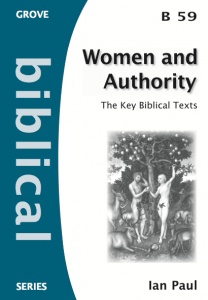
Women and Authority: new Grove booklet

Ian Paul has just announced:
My Grove booklet Women and Authority: the key biblical texts is now available (after a small printing hiccup!) from the Grove website.
This is the booklet whose summary I quoted in a previous post. The booklet costs £3.95, in printed form or as an e-book.
Ian is from the Church of England, but in writing this has also engaged with Roman Catholic and Free Church traditions, as well as primarily with the relevant biblical texts. He writes that while working on the booklet
I have been struck afresh by the radically egalitarian and counter-cultural nature of what Scripture says about gender, and the challenge to the church to be constantly reformed and reshaped by Scripture’s perspective, even if that means letting go of cherished traditions of interpretation.
This looks like being an excellent introduction to these issues.